In EMS, precision isn’t just a goal, it’s a necessity. From onboarding to ongoing education, every learning requirement must be tracked, completed, and documented. But when those requirements live in separate systems—or worse, on spreadsheets—progress stalls, accountability slips, and compliance becomes a moving target.
Fragmented Tools, Manual Burden
EMS agencies are tasked with managing a complex web of training requirements: orientation, continuing education, skills checklists, policy acknowledgments, and more. Yet many organizations still rely on disconnected systems or manual processes to track it all.
This fragmentation creates inefficiencies and risks. Managers spend hours chasing down completions, verifying documentation, and manually assigning tasks. It’s not just time-consuming, it’s error prone.
The Commission on Accreditation of Ambulance Services (CAAS) recognizes this challenge. In Standard 105.06, CAAS outlines the need for structured employee training and development, including orientation and ongoing education programs that are clearly documented and consistently applied [1].
Compliance Gaps and Operational Drag
When learning requirements are scattered across platforms—or buried in inboxes—teams fall out of sync. New hires may miss critical onboarding steps. Field staff may fall behind on required training. And compliance officers are left scrambling during audits.
The Commission on Accreditation of Medical Transport Systems (CAMTS) addresses this in Standard 03.05.00, which requires accredited programs to demonstrate how they track, evaluate, and document orientation and continuing education [2]. Without a centralized system, meeting these standards becomes a logistical headache.
Ninth Brain’s Evolving Goal Track Ecosystem
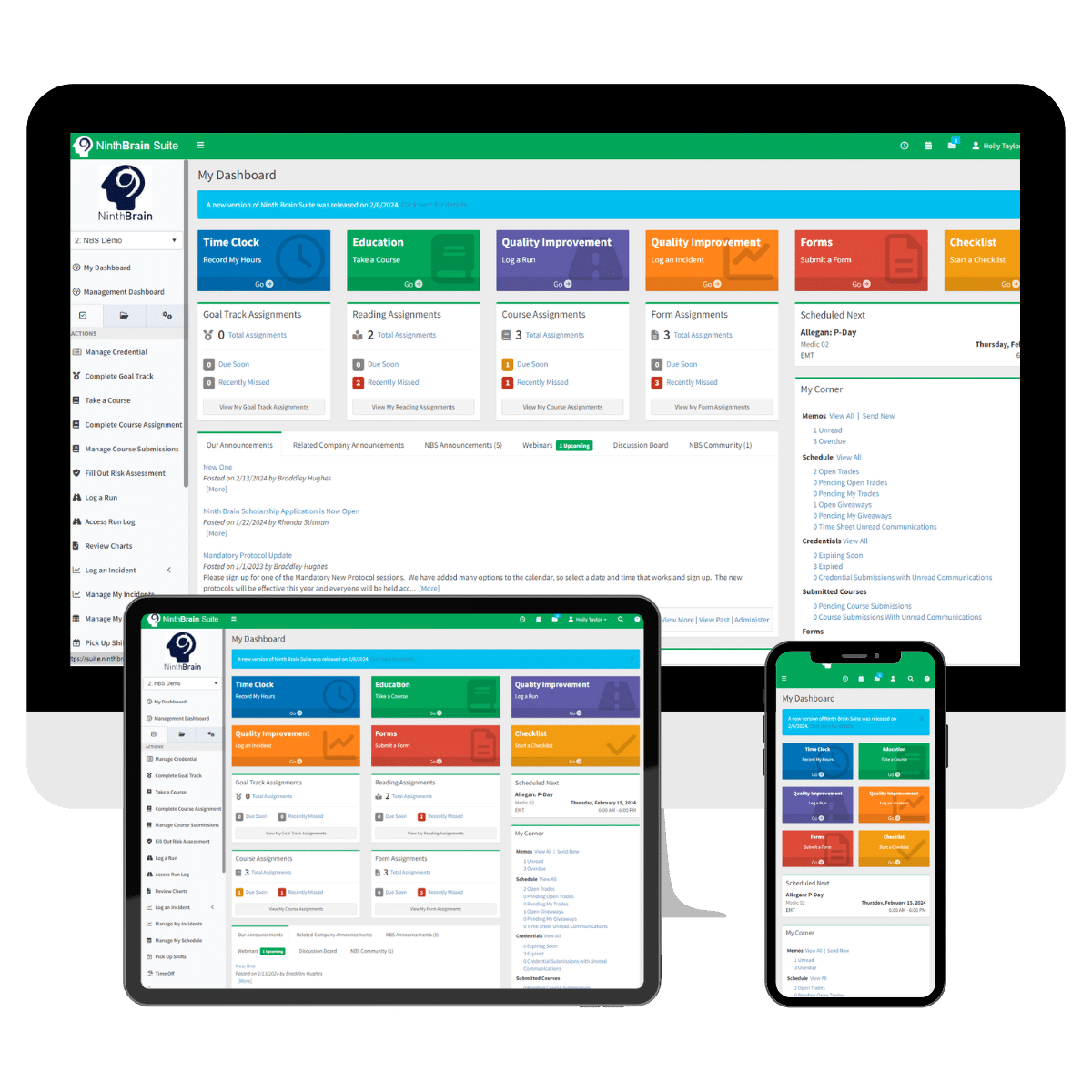
Ninth Brain’s Goal Track was designed to solve this exact problem. What began as a simple way to assign learning tasks has evolved into a fully integrated ecosystem that supports:
- Education
- Reading assignments
- Forms & Checklists
With automated assignment rules, Goal Track ensures the right tasks reach the right people at the right time—whether it’s based on hire date, or a recurring interval.
And because it’s part of the broader Ninth Brain platform, Goal Track doesn’t operate in a silo. It connects seamlessly with credential tracking, giving managers a real-time view of team progress and gaps.
As we explain in one of our other blogs on EMS training challenges, “When systems don’t talk to each other, it’s easy for things to fall through the cracks. That’s why integrated platforms are essential for modern EMS agencies” [3].
The Impact: Clarity, Accountability, and Compliance
With Goal Track, EMS leaders can:
- Assign and automate learning tasks with confidence
- Monitor progress across individuals and teams
- Align training with CAAS and CAMTS standards
- Reduce manual follow-ups and administrative overhead
It’s not just about checking boxes—it’s about building a culture of continuous learning and operational excellence.
As eLearning expert Sarah Smith notes, “Integrated LMS platforms improve engagement, reduce errors, and streamline compliance tracking—especially in high-stakes environments like EMS”[4].
Conclusion: A Smarter Way to Stay on Track
Ninth Brain’s Goal Track isn’t just a feature, it’s a foundation. By unifying learning requirements across modules and automating the assignment process, it empowers EMS agencies to stay compliant, aligned, and ready for whatever comes next.
Because when your team’s progress is seamless, your operations are unstoppable.
📚 References
[1]: Commission on Accreditation of Ambulance Services. (2025). CAAS standards version 4.0. https://www.caas.org/wp-content/uploads/2025/01/CAAS-Standards-Version-4.0.pdf
[2]: Commission on Accreditation of Medical Transport Systems. (2025). CAMTS 12th Edition Standards. https://www.camts.org/resources
[3]: Ninth Brain. (n.d.). Top challenges EMS agencies face with training compliance. https://ninthbrain.com/top-challenges-ems-agencies-face-with-training-compliance
[4]: Smith, S. (2024, September 25). Exploring the advantages of LMS for healthcare and medical emergency staff training. eLearning Industry. https://elearningindustry.com/exploring-the-advantages-of-lms-for-healthcare-and-medical-emergency-staff-training
Starting a new job in EMS is a big deal. Those first few days? They can shape how someone feels about their role, their team, and even their future in the field. But too often, new hires are thrown into the mix with little structure or support. And in emergency medical services, that kind of uncertainty can lead to real problems.
🚨 The Problem: Inconsistent Onboarding Hurts Everyone
Picture this: two EMTs start on the same day. One gets a checklist, a mentor, and a clear plan. The other? They’re told to “shadow and learn.” It’s no surprise that confusion sets in, protocols get missed, and it takes longer for them to feel like part of the team.
This kind of inconsistency isn’t just frustrating, it’s risky. Without a solid onboarding process, agencies face higher turnover, lower morale, and even legal trouble. That’s why the National EMS Management Association (NEMSMA) created EMS-FTEP™, a structured onboarding model that helps new hires succeed and keeps agencies protected (NEMSMA, 2016).
✅ The Solution: Goal Track by Ninth Brain
That’s where Goal Track comes in. It’s designed to take the guesswork out of onboarding and give EMS leaders the tools to build a clear, consistent path for every new team member.
With Goal Track, you can:
- Put each piece of the onboarding journey into a single assignment with a clear due date. Track progress so nothing slips through the cracks.
- Control who sees what, so the right people get the right info.
The result? Every new hire gets the same high-quality experience—no matter who their supervisor is or what shift they’re on.
📋 Why It Matters: Compliance and Accreditation
Let’s be real—structured onboarding isn’t just a “nice to have.” It’s a must-have if you want to stay compliant with EMS accreditation standards. Goal Track supports:
- CAAS 106.06.01 Orientation Training
- CAMTS 03.05.00 Orientation, Training and Initial and Continuing Education
These standards are all about making sure training is consistent and well-documented. The National Registry of Emergency Medical Technicians (NREMT) also backs structured education as a way to boost efficiency and prepare EMS professionals for the real world (NREMT, 2016).
🚀 The Benefits: Faster Integration, Better Outcomes
When agencies use structured onboarding, the results speak for themselves:
- New hires get up to speed faster.
- Training is more effective and easier to retain.
- Admins spend less time chasing paperwork.
- Teams feel more connected and confident.
And as NEMSMA points out, programs like EMS-FTEP™ don’t just improve performance—they help agencies avoid legal headaches tied to poor training practices (NEMSMA, 2016).
👣 Ready to Transform Your Onboarding?
If your onboarding process still feels a bit “make it up as we go,” it’s time for a change. Ninth Brain’s Goal Track gives you everything you need to build a consistent, compliant, and effective onboarding experience that sets your team up for success.
Ready to see it in action? Explore Goal Track and discover how structured onboarding can elevate your EMS agency.
Sources:
National EMS Management Association (NEMSMA). (n.d.). EMS-FTEP: EMS Field Training and Evaluation Program. Retrieved June 10, 2025, from https://www.nemsma.org/page/EMS-FTEP
National Registry of Emergency Medical Technicians (NREMT). (n.d.). Information for EMS educators & programs. Retrieved June 10, 2025, from https://www.nremt.org/Partners/EMS-Educators
Wondering if Ninth Brain is the right fit? Let’s Connect and Explore!