In EMS, precision isn’t just a goal, it’s a necessity. From onboarding to ongoing education, every learning requirement must be tracked, completed, and documented. But when those requirements live in separate systems—or worse, on spreadsheets—progress stalls, accountability slips, and compliance becomes a moving target.
Fragmented Tools, Manual Burden
EMS agencies are tasked with managing a complex web of training requirements: orientation, continuing education, skills checklists, policy acknowledgments, and more. Yet many organizations still rely on disconnected systems or manual processes to track it all.
This fragmentation creates inefficiencies and risks. Managers spend hours chasing down completions, verifying documentation, and manually assigning tasks. It’s not just time-consuming, it’s error prone.
The Commission on Accreditation of Ambulance Services (CAAS) recognizes this challenge. In Standard 105.06, CAAS outlines the need for structured employee training and development, including orientation and ongoing education programs that are clearly documented and consistently applied [1].
Compliance Gaps and Operational Drag
When learning requirements are scattered across platforms—or buried in inboxes—teams fall out of sync. New hires may miss critical onboarding steps. Field staff may fall behind on required training. And compliance officers are left scrambling during audits.
The Commission on Accreditation of Medical Transport Systems (CAMTS) addresses this in Standard 03.05.00, which requires accredited programs to demonstrate how they track, evaluate, and document orientation and continuing education [2]. Without a centralized system, meeting these standards becomes a logistical headache.
Ninth Brain’s Evolving Goal Track Ecosystem
Ninth Brain’s Goal Track was designed to solve this exact problem. What began as a simple way to assign learning tasks has evolved into a fully integrated ecosystem that supports:
- Education
- Reading assignments
- Forms & Checklists
With automated assignment rules, Goal Track ensures the right tasks reach the right people at the right time—whether it’s based on hire date, or a recurring interval.
And because it’s part of the broader Ninth Brain platform, Goal Track doesn’t operate in a silo. It connects seamlessly with credential tracking, giving managers a real-time view of team progress and gaps.
As we explain in one of our other blogs on EMS training challenges, “When systems don’t talk to each other, it’s easy for things to fall through the cracks. That’s why integrated platforms are essential for modern EMS agencies” [3].
The Impact: Clarity, Accountability, and Compliance
With Goal Track, EMS leaders can:
- Assign and automate learning tasks with confidence
- Monitor progress across individuals and teams
- Align training with CAAS and CAMTS standards
- Reduce manual follow-ups and administrative overhead
It’s not just about checking boxes—it’s about building a culture of continuous learning and operational excellence.
As eLearning expert Sarah Smith notes, “Integrated LMS platforms improve engagement, reduce errors, and streamline compliance tracking—especially in high-stakes environments like EMS”[4].
Conclusion: A Smarter Way to Stay on Track
Ninth Brain’s Goal Track isn’t just a feature, it’s a foundation. By unifying learning requirements across modules and automating the assignment process, it empowers EMS agencies to stay compliant, aligned, and ready for whatever comes next.
Because when your team’s progress is seamless, your operations are unstoppable.
📚 References
[1]: Commission on Accreditation of Ambulance Services. (2025). CAAS standards version 4.0. https://www.caas.org/wp-content/uploads/2025/01/CAAS-Standards-Version-4.0.pdf
[2]: Commission on Accreditation of Medical Transport Systems. (2025). CAMTS 12th Edition Standards. https://www.camts.org/resources
[3]: Ninth Brain. (n.d.). Top challenges EMS agencies face with training compliance. https://ninthbrain.com/top-challenges-ems-agencies-face-with-training-compliance
[4]: Smith, S. (2024, September 25). Exploring the advantages of LMS for healthcare and medical emergency staff training. eLearning Industry. https://elearningindustry.com/exploring-the-advantages-of-lms-for-healthcare-and-medical-emergency-staff-training
Starting a new job in EMS is a big deal. Those first few days? They can shape how someone feels about their role, their team, and even their future in the field. But too often, new hires are thrown into the mix with little structure or support. And in emergency medical services, that kind of uncertainty can lead to real problems.
🚨 The Problem: Inconsistent Onboarding Hurts Everyone
Picture this: two EMTs start on the same day. One gets a checklist, a mentor, and a clear plan. The other? They’re told to “shadow and learn.” It’s no surprise that confusion sets in, protocols get missed, and it takes longer for them to feel like part of the team.
This kind of inconsistency isn’t just frustrating, it’s risky. Without a solid onboarding process, agencies face higher turnover, lower morale, and even legal trouble. That’s why the National EMS Management Association (NEMSMA) created EMS-FTEP™, a structured onboarding model that helps new hires succeed and keeps agencies protected (NEMSMA, 2016).
✅ The Solution: Goal Track by Ninth Brain
That’s where Goal Track comes in. It’s designed to take the guesswork out of onboarding and give EMS leaders the tools to build a clear, consistent path for every new team member.
With Goal Track, you can:
- Put each piece of the onboarding journey into a single assignment with a clear due date. Track progress so nothing slips through the cracks.
- Control who sees what, so the right people get the right info.
The result? Every new hire gets the same high-quality experience—no matter who their supervisor is or what shift they’re on.
📋 Why It Matters: Compliance and Accreditation
Let’s be real—structured onboarding isn’t just a “nice to have.” It’s a must-have if you want to stay compliant with EMS accreditation standards. Goal Track supports:
- CAAS 106.06.01 Orientation Training
- CAMTS 03.05.00 Orientation, Training and Initial and Continuing Education
These standards are all about making sure training is consistent and well-documented. The National Registry of Emergency Medical Technicians (NREMT) also backs structured education as a way to boost efficiency and prepare EMS professionals for the real world (NREMT, 2016).
🚀 The Benefits: Faster Integration, Better Outcomes
When agencies use structured onboarding, the results speak for themselves:
- New hires get up to speed faster.
- Training is more effective and easier to retain.
- Admins spend less time chasing paperwork.
- Teams feel more connected and confident.
And as NEMSMA points out, programs like EMS-FTEP™ don’t just improve performance—they help agencies avoid legal headaches tied to poor training practices (NEMSMA, 2016).
👣 Ready to Transform Your Onboarding?
If your onboarding process still feels a bit “make it up as we go,” it’s time for a change. Ninth Brain’s Goal Track gives you everything you need to build a consistent, compliant, and effective onboarding experience that sets your team up for success.
Ready to see it in action? Explore Goal Track and discover how structured onboarding can elevate your EMS agency.
Sources:
National EMS Management Association (NEMSMA). (n.d.). EMS-FTEP: EMS Field Training and Evaluation Program. Retrieved June 10, 2025, from https://www.nemsma.org/page/EMS-FTEP
National Registry of Emergency Medical Technicians (NREMT). (n.d.). Information for EMS educators & programs. Retrieved June 10, 2025, from https://www.nremt.org/Partners/EMS-Educators
If you’re an EMS training coordinator, chances are you’re juggling a lot—spreadsheets, emails, paper forms, and maybe even a few sticky notes. Between tracking CE credits and organizing in-person training, it’s easy to feel like you’re constantly playing catch-up. And when compliance is on the line, that’s not a game anyone wants to lose.
The Challenge: Two Big Headaches
📚 External CE Credits
Let’s face it—your team doesn’t always take their CE courses through your LMS. They might attend conferences, webinars, or external classes. That’s great for flexibility, but not so great when you’re the one trying to track it all down.
The Joint Commission points out that accurate CE tracking is critical for licensure and quality care1. But when you’re chasing down certificates and manually entering data, it’s easy for things to fall through the cracks.
🗓️ In-Person Training Events
Now add in the challenge of managing in-person training. You’re scheduling sessions, tracking who showed up, collecting evaluations, and issuing certificates—often by hand. It’s time-consuming, and honestly, it’s not the best use of your time.
Advance CTE’s Credentials of Value report makes it clear: agencies need smarter systems to track credentials and reduce the admin overload2.
The Solution: Ninth Brain’s Integrated Tools
That’s where Ninth Brain comes in. We’ve built tools that take the stress out of training management—so you can focus on what matters most.
✅ Individual Course Submissions
Staff can upload their external CE certificates directly into the system. No more chasing paperwork or wondering if someone’s credits are up to date. Everything’s in one place, ready for audits or reports.
✅ Central Calendar & Event Management
With our calendar and event tools, you can:
- Set up and manage training sessions.
- Limit registration and create waitlists.
- Track attendance with a few clicks.
- Attach quizzes, surveys, and auto-generate certificates.
It’s like having a personal assistant for your training program—minus the coffee runs.
Compliance and Accreditation
Ninth Brain’s tools are built to support:
- CAAS 106.06.02 & 106.06.03 – Ongoing Education and Continuing Medical Education
- CAMTS 03.05.00 – Orientation, Training, and Initial and Continuing Education
By keeping everything centralized and automated, you’re always ready for audits—and you’ll sleep better knowing your documentation is solid.
The Benefits: Why It’s a Game-Changer
Agencies using Ninth Brain’s training tools report:
- Smoother operations and fewer manual tasks.
- More engaged employees who actually enjoy training.
- Easier compliance tracking and reporting.
- More time to focus on patient care—not paperwork.
Ready to Make Training Easier?
If your current system involves sticky notes and spreadsheet gymnastics, it’s time for an upgrade. Ninth Brain brings everything together in one place—so you can stop managing chaos and start managing smarter.
Let’s simplify, centralize, and succeed—together.
📚 References
1: The Joint Commission. (n.d.). Continuing education credit information FAQs. Retrieved June 10, 2025, from https://www.jointcommission.org/resources/continuing-education-credit-information/continuing-education-credit-information-faqs/
2: Advance CTE. (2019). Credentials of Value: State Strategies for Identifying and Endorsing Industry-Recognized Credentials. Retrieved from https://careertech.org/resource/credentials-of-value
Ninth Brain Doubles EMS World Expo Scholarships for 2025, Celebrating EMS Week by Empowering 100 EMS Professionals!
Frankenmuth, MI – In celebration of EMS Week 2025, Ninth Brain is excited to announce the expansion of its scholarship initiative, doubling the number from last year! Partnering once again with EMS World, Ninth Brain is offering 100 scholarships to support the education and professional growth of EMS personnel across the nation.
Each scholarship recipient will receive a full conference registration for the prestigious EMS World Expo 2025 event in Indianapolis, IN, with the option to attend either virtually or in person. Additionally, recipients attending in person will be awarded a $500 Visa gift card to help cover travel expenses, ensuring greater accessibility for all. Attendees will also receive some exclusive Ninth Brain swag.
“EMS World Expo is the world’s largest and most influential educational and networking event dedicated to EMS professionals,” said Jonathan Bassett, Senior Content and Program Director of EMS World. “We are honored to once again partner with Ninth Brain to send 100 deserving EMS providers to this premier event, where they will gain invaluable knowledge and connect with industry leaders in pre-hospital care.”
“At Ninth Brain, we go beyond software solutions—we are deeply invested in the EMS community,” said Holly Taylor, co-owner of Ninth Brain. “EMS Week is a time to recognize and uplift the incredible professionals who serve our communities, and we are honored to expand this initiative to support 100 individuals as they prepare for one of the industry’s most significant gatherings.”
EMS professionals eager to take advantage of this remarkable opportunity can apply online at https://ninthbrain.com/ems-week-2025
The application window opens on May 19th and closes on June 9th, 2025. Don’t miss this chance to be part of an extraordinary event!
—————
About Ninth Brain: Ninth Brain Suite, LLC, established in 2001, provides a comprehensive software solution designed to help EMS organizations manage daily operations, including credential tracking, education, workforce scheduling, and compliance. By streamlining complex processes, Ninth Brain allows EMS professionals to focus on their primary mission—saving lives. For more information, visit www.ninthbrain.com.
—————
About EMS World: EMS World serves the full spectrum of emergency medical services providers: EMTs, paramedics, dispatchers, physicians, nurses, educators, researchers, and administrators. Through print publications, websites, podcasts, webinars, and the world’s largest EMS-dedicated annual conference, EMS World Expo, EMS World is the leading authority on providing expert-guided clinical, management, and regulatory content to a discerning and dedicated audience on the front lines of out-of-hospital care.
For any questions, please contact sales@ninthbrain.com.
Emergency Medical Services (EMS) providers require specialized training and knowledge to effectively fulfill their roles. Whether working alone or within teams, emergency response personnel need to be able to adapt and respond to ongoing changes in the industry while adhering to best practices.
For many, that means continuing their education throughout their careers so they can keep up with the demands of the job, but it can prove difficult for full-time EMS employees to stay on top of their required training. Luckily, most EMS workers today have access to online courses that offer a more flexible learning environment.
Furthering your EMS education via online training is excellent, as well as essential, but knowing where to start can be difficult. Therefore, it’s important to get started as early as possible, so you can get back to helping people just as quickly.
Why Is EMS Education Important?
Emergency medical services are critical in keeping people safe, and EMS providers must have a deep, up-to-date understanding of current best practices so they can offer proper care and ensure they remain compliant with legal standards.
Failing to do so can result in liabilities for both the individual and their employer, and gaps in knowledge can leave EMS personnel unable to properly perform essential tasks, potentially putting others in great danger.
Therefore, EMS education is designed to ensure workers have all the knowledge and training they need to succeed in their roles. Having the proper educational framework in place prevents unexpected incidents and gives workers the opportunity to develop professionally.
How Can Online Training Help Improve EMS Education?
It’s important that EMS providers continue to learn, even while on the job, to ensure they do not forget anything important. However, with such busy schedules, it can be difficult to find the time to take the proper courses.
Online training helps improve EMS education by offering specialized courses that personnel can access at any time. Courses offered digitally can track a worker’s progress and make recommendations in real-time, creating a more personalized learning environment while also reducing overhead costs and allowing leaders to collaborate across multiple channels, making it much more convenient for organizations at large.
The Best Online Training Programs for EMS Education
With so many options available, it can be difficult for EMS workers to know where to start. In response, organizations should work to provide a basic framework that employees can follow, complete with support options, learning materials, and ongoing feedback. Understanding the benefits of online training programs will help EMS workers focus on learning, making it easier to keep everyone up to date with the latest information.
Below are some of the most common courses, which focus on managing equipment and dealing with workplace hazards.
Resource Management
Knowing what’s available, how to use it, and when it needs to be replaced are essential skills for EMS providers. Tasks associated with inventory management, finances, and material costs can be difficult to take on without the proper knowledge, but a resource management course gives EMS providers the ability to properly care for their equipment and understand what to do when things start to break down. It can also help teams operate more efficiently by using what they have.
PPE
Personal Protective Equipment (PPE) is vital on any worksite that poses potential hazards or dangers to employees. EMS workers should be aware of what their rights and responsibilities are regarding PPE usage on the job at all times. Hard hats, gloves, fireproof clothing, and eyewear are only some of the things that emergency responders must know how to properly use when responding to a dangerous scene or working in a sterile environment.
Infectious Diseases
EMS personnel should constantly be aware of any dangers personally posed to them throughout the course of their duties. One of the biggest threats, especially to medical workers, is the spread of infectious diseases and other illnesses. Staying on top of the latest vaccines and adhering to all necessary sanitation practices are just a few of the things that EMS providers will need to be up to date on in their continuing of education.
Coping with Stress
Responding to emergency situations and providing aid can be incredibly harrowing, so EMS providers need to understand how to best deal with any ongoing mental and emotional trauma in order to stay healthy and well-balanced. Whether it’s done through counseling or some other activity, learning to cope with stress is one of the most fundamental skills that online training programs can cover.
Lifelong Learning Is Part of Public Service
No matter what role an EMS provider takes on, being in public service comes with a level of responsibility to both oneself and others. Taking the time to complete the latest coursework gives EMS providers a chance to catch up with changes in the industry or to brush up on things they may have forgotten. As such, EMS education is an essential activity that must be done properly to promote public safety and reduce the risk of accidents occurring while providing care.
Saving lives is no easy task, but Emergency Medical Services (EMS) providers are entrusted with doing just that, and due to the critical nature of their day-to-day operations, rigorous protocols must be in place to ensure deficiencies are properly addressed.
In their field, that means EMS providers must carefully document each step of their processes to ensure that their results can be validated against long-term goals.
Handling documentation can be complicated, especially when just starting out, so for those who want to deliver the best EMS services possible, it’s essential to be aware of some of the most common documentation mistakes and understand how to avoid them.
Why Is EMS Documentation Important?
Proper EMS documentation requires a record of care, which details everything from their initial contact with a patient until that transfer of patient care. Having a record of care for response management makes it easier to look back at how certain problems were handled to determine whether core commitments were met.
Resource use, training protocols, and management decisions should all be carefully documented to eliminate inefficiencies and obtain better results. It’s also important for liability reasons, as strict documentation is important for legal reporting.
What to Avoid When Doing EMS Documentation
Documenting everything right away is essential to get accurate results, especially for EMS services. The use of common methods to eliminate errors from the documentation process allows respondents to improve their response times, on-scene management, and quality of care.
With so much at stake, it’s vital that EMS organizations properly prepare their employees with adequate training, support, and documentation of their roles. Beyond that, EMS providers should take the time to ensure they’re comfortable with covering their documentation before doing it on their own.
There are quite a few things to keep in mind when documenting EMS services, but avoiding errors is easy if you know what to look out for, such as the following:
1. Failing to Document Mistakes
Frequent errors, hazards, and resource limitations should all be accounted for so that decision-makers can do something about them. It can be tempting to simply erase a mistake and start over, but it’s crucial that you do not leave anything out of your reports. Be open and honest in your reporting so supervisors can see and be aware of deficiencies before they cause further issues.
2. Waiting to Document
Another common mistake that those new to EMS services make is waiting too long to report things. It’s easy to forget things, and waiting too long can severely affect a worker’s quality of reporting. Misleading information can have drastic consequences, so it’s important that they write things down when they’re still fresh in their mind.
3. Have an Outline
It’s easy to make mistakes when completing similar, monotonous, and repetitive tasks. Employees that rush through these tedious aspects of the job are more likely to make mistakes, which makes it essential to have a solid plan of action before even starting the documentation process.
Things will be different in every circumstance, but using outlines and templates can make it easier to manage things and get them done without slipping up. Doing so also saves time, as much of the repeatable language and information can be simply reused.
4. Revise and Edit
Reporting mistakes are commonplace, so it’s important to go over everything thoroughly, at least once, to ensure that the information is as accurate as possible and to avoid the biggest errors.
Consistency and accuracy will make your documentation much more reliable, and validating data, fixing spelling and grammar mistakes, and considering the overall structure of the report will allow you to improve your documentation methods over time.
5. Be Thorough
When it comes to the field of EMS, you can never have too much information, but rookies often make the mistake of limiting the amount of information they report, not wanting to overwhelm the reader. However, for decision-makers, well-organized and thorough reporting is one of the most valuable assets available to them.
It’s important to document everything accordingly and ensure that references, receipts, and other relevant pieces of information are provided alongside it so that they don’t have to be hunted down later.
Proper Documentation Is Essential for EMS Workers
In any industry, documentation provides a paper trail that allows decision-makers to go back and look through operational data for relevant information. The ability to do so is especially useful for EMS organizations, where strict quality control standards are always enforced. For rookies, knowing what mistakes to avoid can ensure they grow into their role without developing bad habits.
Ensuring documentation syncs with company policies takes ongoing effort and a long-term vision. Looking at common areas of interest, limiting the potential for bad reporting, and offering support and communication for misreporting will add value to the organization and allow EMS leaders and workers alike to focus their efforts on helping the public.
Most people experience some level of stress in their everyday lives, but for EMS providers, it can be especially difficult to deal with. With so many things going on and a lack of any real certainty in daily life, it can be hard to adjust.
Stress can also make it much harder to concentrate or get sufficient rest and lead to health complications such as high blood pressure and diabetes. As such, knowing the causes of their stress and how to deal with them is essential for EMS providers who want to deliver the best care possible to those in need.
What Kind of Stress Does an EMS Provider Experience?
There’s no shortage of overwhelming challenges on the job, meaning that EMS providers deal with all sorts of stress daily. Some common sources of stress include the following:
- Interpersonal conflicts
- A dynamic working environment
- Increased overtime
- Required skill training
- Changes in rules or protocol
EMS providers must be able to deal with these issues and manage their stress to ensure they deliver proper care. To that end, having a few good practices under your belt can go a long way in getting through bad experiences without straining yourself.
How Can EMS Providers Manage Stress?
It’s not always easy to get started with stress management. Most people choose one or two good techniques that work for them and go from there. No matter how you approach it, it’s important to stick with your management plan so you can develop positive habits that you don’t even have to think about.
With that being said, perhaps the best way to manage stress is to have consistent activities that allow you to reduce your anxiety over time. If you’re an EMS provider with low energy or poor health, you may need to consider changing your routine to focus better on your mental well-being.
1. Exercise Regularly
Any type of exercise can improve your mood, increasing endorphin production and reducing the number of stress hormones that circulate throughout your body. Regular movement gets rid of tension and allows you to relax more easily. It can also improve your overall quality of life by increasing resilience to illnesses and diseases and promoting natural longevity.
Walking, running, biking, and swimming are just a few of the most common exercises people use to relieve anxiety, and these activities can be especially useful to EMS providers since they can be done nearly anywhere without any sort of advanced equipment.
2. Do Resilience Training
The ability to deal with stress and manage it through healthy activities and mental clarity doesn’t come easy to everyone. For EMS providers, resilience training is essential for building a psychological resistance to harm caused by stressful situations that are encountered while in the field.
Recognizing and understanding which stressors they’re most vulnerable to can give EMS providers a better idea of how to deal with stress, and learning to cope with those setbacks, deal with depression, and bounce back from stressful situations will lead to happier and healthier lives.
3. Find a Support Network
It can be difficult to deal with stress alone, and such is especially true for EMS providers, who encounter traumatic situations on a regular basis. Having a group of like-minded individuals that understand what is going on can work wonders for those experiencing high amounts of stress.
With a solid support network in place, it’s easier to communicate your emotional state and receive feedback from others, which can help put things into context. You can also reach out to someone if you’re feeling especially vulnerable.
4. Try Deep Breathing and Meditation
For some people, stress can make it harder to think clearly and focus on the task at hand, which can be dangerous if not dealt with correctly. In such a case, it might help to try some deep breathing or meditation exercises that allow you to just sit still and adjust your mind for a little while.
Deep breathing has a calming effect and can help you relax when stressed. Allowing the increased oxygen to flow through your blood will slow your heartbeat and allow you to adjust your mental state.
Attention to Mental Health Is Essential for EMS Providers
EMS providers deal with traumatic and otherwise incredibly stressful situations day in and day out. If such high anxiety isn’t dealt with correctly, it can lead to high blood pressure, difficulty breathing, and even panic attacks. Any one of these issues can be problematic for individuals responding to emergency situations.
No matter what type of field you work in, paying attention to your mental health is essential for improved quality of life. By taking the time to focus on yourself and learn how to deal with stress, you can get better sleep, maintain your health, and improve your mood.
Good mental health can mean the difference between helping and hurting for EMS providers. With the right mental health exercises, EMS providers can properly manage their stress and ensure the safety of others.
Disaster management is a vital service that aims to mitigate the harmful effects of emergency situations. Public safety and health make communities more prosperous and improve the quality of life for everybody.
Modern emergency responders have a clear knowledge of what to do when disaster strikes and provide a systematic way for societies to deal with unexpected incidents.
Emergency response services are an important part of everyday life and give communities the tools they need to deal with emerging situations. Whether they’re police, fire, or medical personnel, first responders must be prepared to follow guidelines in hectic situations and offer guidance when people need it most.
What Are Emergency Response Services?
Emergency response services are designed with a clear set of strategies and goals in mind. For those in the field, the execution of emergency response duties can have a clear impact on the communities they serve.
This work can mean creating guidelines, offering support during emergencies, or providing public knowledge and training to ensure future incidents are less likely to occur.
With emergency response services in place, incidents can be handled quickly and with less panic. By doing everything they can to prepare before disaster strikes, emergency response services provide a means to mitigate risk and manage incidents.
Whether it’s incident response, disaster recovery, or suicide and crisis prevention, emergency response services provide a means to protect the most vulnerable members of the population from harm.
Incident Response
When accidents occur, it’s important to have trained professionals who know what they’re doing, so things aren’t made worse. Emergency response training allows responders to develop their skills before going into the field, making it easier to manage situations and help the people who need it the most.
Stabilizing urgent medical situations involves considering potential hazards and taking the necessary precautions to mitigate further harm. Emergency response services offer a means for assessing risk and deploying strategies for dealing with targeted areas of emergency response.
Disaster Management
Disasters can strike at any time. When they do, it’s often the first responders who are there to offer security and recovery to the public. Disaster management is a vital part of emergency response, and emergency response services are the ones with the resources and training to deal with it.
Strategically moving assets, communicating with victims, and delivering life-saving services are essential steps to take post-disaster. Emergency response means developing a plan beforehand so it can be implemented at a moment's notice.
Suicide and Crisis Prevention
For many dealing with suicidal thoughts or other crises, there’s often nobody to reach out to for help. As society has become more aware of this problem, emergency response services have been shifted to provide needed resources and personnel for helping victims.
Suicide and crisis prevention services drastically reduce the risk of death by suicide — individuals who are thinking about self-harming have access to professionals who will help them through their emotions.
Emergency response services come in many shapes and sizes. Suicide and crisis prevention services, such as 9-8-8, provide a lifeline for individuals who may have nowhere else to turn.
What Is 9-8-8?
9-8-8 is the phone number for The National Suicide Prevention Lifeline in the United States. Those dealing with substance abuse, mental illness, and other crises can contact a professional at 9-8-8 to receive personal help.
The 9-8-8 implementation reinforces public safety and ensures everybody has access to core mental health services.
After mounting criticism of the country’s lack of capable services, the line was established across state and local regions to give support to those who need it. As of July 2022, the hotline provides 24/7 call, text, and chat services for individuals who are experiencing distress or suicidal thoughts.
The number will route incoming calls to trained counselors who can then provide the necessary support and resources.
What Does 9-8-8 Mean for the Future of Emergency Response?
Suicide prevention has been a missing feature in the U.S. strategy for ER preparedness. For those with mental health problems, it can be difficult to get the proper help and find lasting solutions. With the addition of 9-8-8, vulnerable individuals will have an opportunity to find the needed support before it’s too late.
As suicide rates and mental health problems continue to rise, people need a place to turn to for help. 9-8-8 gives you access to compassionate people who care and have the skills to help you through a crisis. This access is essential for those who have nowhere else to go.
Before 9-8-8, crisis prevention hotlines were overwhelmed with the number of people calling in. This saturation made it difficult to offer help and support to people in need.
Like 9-1-1, 9-8-8 was designed to be easy to remember and quick to dial. This setup allows people to connect with professional services that are there for them without having to wait or pay for a solution.
When patients need critical care, first responders are there to ensure they receive the best medical treatment possible. Emergency medical services (EMS) allow experienced professionals to respond to reported incidents and offer their help and expertise to those on the scene.
With emergency incidents on the rise and a limited number of workers available to fill valuable roles, teams must have access to all the resources they need to get things done. Any number of complications can derail a response.
Understanding the complexity of EMS in the real world is essential for promoting best practices and ensuring people receive timely care.
The Complexity of EMS
Healthcare is an ongoing service that requires continuous attention and knowledge of current best practices. For many healthcare workers, critical links in the response chain are meant to eliminate errors and provide consistent results.
EMTs, paramedics, and other critical health service providers can use these common best practices to offer vital pre-hospital care for patients who are facing life-threatening situations. However, when the lines of communication break down, there can be severe consequences.
What Do EMS Teams Do?
Providing quality health services requires coordination from multiple fronts. An EMS team is meant to leverage the potential of each individual by having them work with others who complement their strengths. EMS teams are an effective way to deal with real-world health emergencies and disasters.
Each member of an EMS team is certified in providing on-the-scene medical treatment, making critical decisions, and offering valuable support and information to those who need it.
All team members have to be on the same page about specific priorities, rules, and responsibilities to deliver effective emergency response efforts for the public. This requirement makes communication across the whole team essential to their role.
What Do EMS Teams Need to Communicate?
EMS teams and team members can’t fill their roles in isolation. They need everybody on each team, including management, to understand the importance of communication for teamwork.
EMS teams can make or break a hospital’s ability to provide effective patient care. Having teams capable of communicating information and coordinating their efforts is essential for delivering quality service and ensuring the proper service of the community.
Tips for Communication with EMS Teams
Here are some tips for improving communication among your EMS teams:
Look for Quality Gaps
Unseen gaps in communication present vulnerabilities when responding to emergencies. This reality makes it harder for teams to effectively mitigate potential harm or provide service to those who need it.
EMS teams should work to identify and fill gaps in their communication channels before these gaps become a problem. Failure on the part of any party to ask questions or provide follow-ups can result in the inability to deliver adequate care.
With the right communication systems in place, EMS teams will have everything they need to care for patients in emergencies.
Learn to Operate in Parallel
Leadership is important, but in many emergencies, EMS responders have to make their own decisions with little time to spare. Simultaneous planning and execution of multi-part strategies across different physical locations are essential for EMS teams to do their jobs.
Following orders, while adapting to real-world situations requires flexibility and real-time communication capabilities. When EMS teams operate in parallel, they can perform more complex tasks without requiring rigid top-down command structures.
Taking the time to teach each member how to be a leader allows EMS teams to provide better response services with less planning.
Find the Right People for the Job
Even with the right training, some individuals simply don’t work together. Good communication requires people to be on the same page about their roles on the team and what tasks they’re meant to perform. Those who cannot work with others may not be right for the job.
Having good communication skills is essential for contributing to a team. EMS teams need to be able to adapt and respond to immediate changes in the environment without losing sight of their core objectives. Observing, listening, and understanding what information matters makes navigating stressful situations less risky.
Leveraging Communication Skills for EMS
Industries that demand compliance, training, and coordination must be able to adapt to changing circumstances. It’s no different for those operating in EMS.
When teams cannot access the latest tools, equipment, and training, they’re limited in their ability to deliver quality service. For EMS teams, this can mean the inability to respond properly in an emergency.
Communication skills should be a core part of any EMS team. This capability means being able to effectively relay important messages without becoming distracted or compromising the information.
Respecting others, acting with empathy, and being open-minded are all essential traits for any EMS worker. By speaking with clarity and acting precisely, EMS workers can demonstrate their confidence and become valuable members of their respective teams
Becoming an emergency medical technician (EMT) can be rewarding and fulfilling. EMTs are trained to provide essential life support for patients injured or suffering from a medical emergency, such as an asthma attack, heart attack, or stroke.
EMTs are first responders on the scene of an accident or medical crisis and provide care before the patient arrives at the hospital. Students may complete coursework online to pursue an EMT certification or paramedicine degree.
Online courses provide convenience and flexibility for students who want to become EMTs without sacrificing their regular jobs and family responsibilities.
How Long Does It Take to Get an Online EMT Education?
The length of your online EMT education will depend on which program you choose to enroll in. Different programs offer different durations, so you will need to think about which one will work best for your needs.
In most cases, students can complete their online EMT education within four months or less. Some programs may take up to six months to complete, but most students do not find this a problem because they can work at their own pace.
Who Offers Online EMT Education?
Various educational organizations offer online EMT training and certification or preparation classes. Some are affiliated with individual schools, while others are stand-alone organizations that provide a variety of EMS courses for individuals seeking initial certification or recertification through continuing education units (CEUs).
What Will You Learn During Your Online EMT Education?
The following are some of the topics that you will learn about during your online EMT education:
- Basic anatomy and physiology
- Primary care procedures
- Airway management
- Cardiac emergencies and management
Basically, during your online EMT education, you will learn everything you need to know to perform your job duties as an emergency medical technician.
What Are the Benefits of Getting an Online EMT Education?
If you cannot find the time to take classes in the traditional classroom setting, then an online EMT education might be for you. An online EMT education can be extremely convenient, especially if you already work full-time or have a busy home life. Below find some of the benefits of getting an EMT education online.
Flexible Scheduling
The online EMT education is beneficial for people who have a busy schedule but are interested in pursuing a career as an EMT.
One of the most significant benefits of getting an online EMT education is the ability to work at your own pace. Try online EMT training if you are currently working or have other responsibilities that prevent you from attending a traditional classroom. It provides you with the flexibility to complete your studies at home and on your own time.
If you are a parent or have other family obligations, an online EMT education is also beneficial because you can plan your study schedule around your family’s needs. If your child is sick and you need to stay home with them, you can take the day off from school without worrying that it will affect your grade.
Affordability
Online programs are usually more affordable than traditional colleges and universities since there are no physical buildings for which you have to pay tuition costs. Online programs typically charge a flat rate for each course or credit hour, making them more affordable than traditional colleges and universities.
Internship Training
Another benefit of getting an online EMT education is that most courses also include an internship in a medical facility to gain practical experience. This experience is often better than classroom training because it allows you to work one-on-one with patients. Some programs also offer a clinical practice where students can care for patients under supervision by qualified instructors.
Experience Quality Education
While many people think that they will not get a quality education without attending classes in person, this could not be further from the truth.
In fact, some of the best colleges offering these types of courses have been accredited by the American Academy of Emergency Medicine (AAEM). These schools provide quality education and training for aspiring paramedics and EMTs.
Is It Time to Pursue EMT Training?
With an online EMT education, you can have the convenience of learning at home and on your own time. Some of these courses are available around the clock to fit the schedules of busy professionals, moms and dads with school-aged kids, and others who seek a fast way to return to the workforce.
Online courses are often less expensive than traditional in-person training due to lower overhead costs and leverage existing course content across a broader student body. This flexibility allows schools to offer a high-quality EMT education at an affordable price.
With an EMT education, you can establish a fulfilling career that offers opportunities for advancement and excellent earning potential. You will be able to serve your community by providing transportation and pre-hospital care in times of emergency, as well as treating patients who are injured or become ill.
As technology advances and online courses become more popular, it has never been easier to get a rewarding education from home. There is no better time than now to consider an online learning program in EMT training.
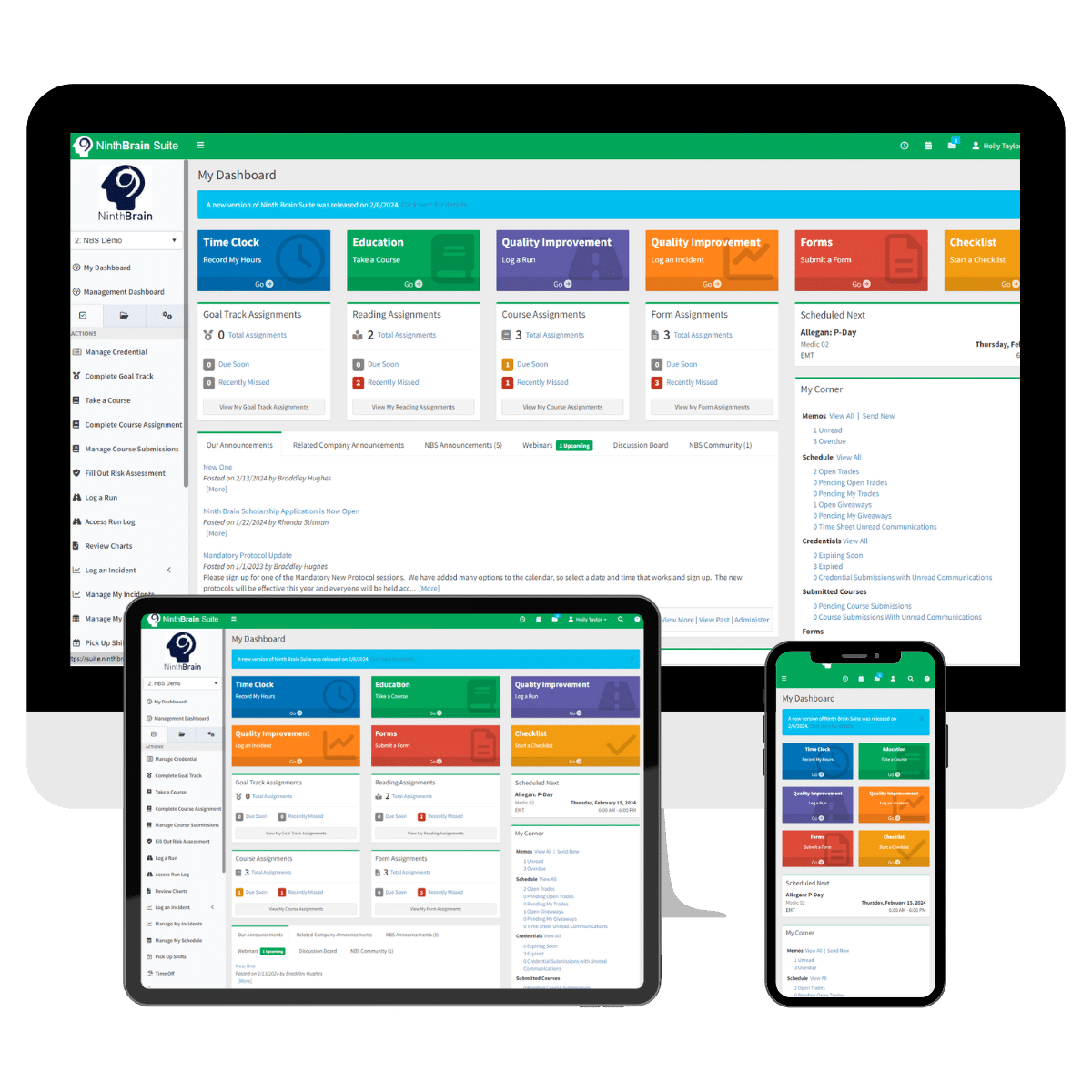
Wondering if Ninth Brain is the right fit? Let’s Connect and Explore!