In healthcare, providers often have to work alongside partners for vital resources, services, and personnel. In such instances, they need to be careful about who they work with. When making emergency decisions, medical providers need to be able to trust those they partner with.
To get a clear picture of potential partners and their backgrounds, EMS agencies need to determine who they can trust. Many agencies look at healthcare exclusions before making their decision.
What is an Exclusion in Healthcare?
The United States Department of Health and Human Services maintains a database of individuals and entities that are no longer able to receive federal funding. This restriction applies to any and all services that the provider offers.
Healthcare organizations that have exclusions can have severe issues operating effectively and delivering care to patients. This reality makes it especially important for legitimate businesses to be weary of working alongside excluded parties.
The existence of exclusion means that the offending party made a grievous error of some sort and will be a liability to those who want to operate effectively.
Why Does a Healthcare Exclusion Occur?
Healthcare exclusions are a vital asset for EMS agencies that want to ensure they deliver the best care to their patients. When healthcare exclusions occur, they should be immediately reported so that future providers aren’t put at risk.
Healthcare exclusions can occur for numerous reasons. A few include:
- Failure to maintain patient safety
- Poor service integrity
- Fraudulent medical reporting
When a healthcare organization violates one of the fundamental tenets of healthcare, it may be excluded from receiving future federal aid, resulting in other organizations not wanting to work with them. EMS agencies protect themselves and their patients by keeping track of excluded entities and refusing to work with them.
What Is Exclusion Monitoring?
Exclusion monitoring is the active assessment of excluded healthcare entities to ensure employees, partners, and other stakeholders aren’t liabilities.
Risks to patient health and safety shouldn’t be tolerated. With exclusion monitoring, EMS agencies can compare information across multiple state and Federal databases to screen for previous infractions.
Working alongside excluded individuals and entities can have drastic consequences that EMS agencies should take stock of when monitoring. These consequences can be in the form of hefty fines, limited funding sources, and other penalties.
Why Is Exclusion Monitoring Important for EMS Agencies?
For EMS agencies, exclusion monitoring presents an essential point of reference when determining whether partners, employees and other stakeholders are qualified for their intended roles. As keeping track of potential liabilities becomes more complicated, medical providers need a reliable way to manage excluded entities.
Screening, reporting, and verification tools simplify exclusion monitoring and reinforce good practice. Routine inspection of reporting will ensure EMS agencies remain compliant, improve safety, and keep good standing with their communities.
Avoid Fines
EMS agencies that work with excluded entities can face fines and other forms of legal punishment for working alongside them. Maintaining compliance and reducing liabilities are essential for healthcare organizations that want to improve their patients’ lives.
With exclusion monitoring, EMS agencies can check on the background of hired individuals, manage their operational data, and make reports on time. This automation will ensure they don’t end up on the exclusion lists themselves.
Reduce Risks
Patient safety should be a priority for EMS agencies. When operating in the field, access to the best services and resources is essential. Excluded entities present inherent risks that make operational integrity less sound.
Exclusion monitoring allows EMS agencies to reduce risk by ensuring they work with the best partners available. By keeping track of excluded entities and individuals, EMS agencies can keep on top of who does and doesn’t pose a risk to their operations.
Maintain Integrity
Having a quality reputation is essential in healthcare. Patient trust requires good standing with the government, and working alongside excluded individuals can make it more difficult to retain funding over time.
Exclusion monitoring builds public trust by incorporating a safety-first framework into core services and operations. Access to a database of excluded individuals allows healthcare organizations to mitigate many of the potential consequences that they would otherwise face when choosing who to do business with.
Using Exclusion Monitoring for Safer Communities
In many communities, knowing that you can trust your healthcare provider is essential for those actively seeking care when it’s needed. For EMS agencies, which need to respond to incidents in real time and deal with ongoing safety issues, having the trust of the public makes it easier to get things done.
When people know they’re getting the best care, they’re more likely to listen to instructions and stay safe during incidents.
Exclusion monitoring keeps communities safe by giving EMS agencies a clear picture of those they’re working with. With exclusion monitoring, EMS agencies can find, verify, and report on individuals and entities, leading to safer communities and more positive participation in emergency response situations.
Traditionally, organizations operating within the emergency medical services, health care, and air medical sectors have been at the forefront of innovation. The talented professionals working in these rewarding career fields are equipped with the latest skills and leading-edge technologies, which they expertly apply to save lives.
However, many EMS and Air Med providers throughout the nation still rely on physical checklists and other forms. While there was a time when these paper-based solutions were the only thing available, that is no longer the case.
In fact, continuing to rely on these antiquated documentation methods can actually have a negative impact on your staff and the organization as a whole!
Below, we’ll examine five reasons why your organization should consider switching to digital checklists and forms. We’ll also provide you with a flexible and dynamic means of doing just that in case you want to learn more about going digital!
1. Reduce Your Costs
As a leader within your organization, you are probably always looking for ways to reduce your operating expenses. However, doing so can be incredibly challenging, especially as the cost of specialized medical supplies and equipment continues to rise.
Fortunately, the transition to digital forms and checklists can be a great cost-saving measure. This will allow you to eliminate the need to print hundreds of paper documents each week.
In addition, you will no longer need to invest in storage equipment such as file cabinets. You can even reduce staffing costs, as less document management is necessary. Instead, everything can be monitored from a single database.
Going digital not only reduces costs — it can also minimize clutter within your office, making it easier to create streamlined workflows.
2. Enhance Accuracy
While accurate documentation is important in all industries, it is particularly essential when you’re tasked with providing medical care to patients. By switching to digital documents, forms, and checklists, your organization can significantly increase the accuracy of the data that it collects.
In the event that information is incorrectly entered, an authorized user can easily locate this data and make necessary corrections. This will be especially beneficial when preparing for accreditation processes.
Another benefit of increasing accuracy through digitization is that it reduces the risks your organization faces from civil liability. Your team can ensure that patients receive adequate care based on accurate data. They can also easily relay this information to other professionals, such as ER staff.
3. Facilitate Real-Time Reporting
Collecting and reviewing physical documents can be a massive headache. To make matters worse, gathering forms and checklists can be extremely time-consuming.
Conversely, digital forms and checklists facilitate real-time reporting capabilities. Your staff can immediately review important documents as soon as they are uploaded to your database. As a result, you can significantly reduce the amount of time that you waste sorting, analyzing, compiling, and reporting on data.
4. Increase Mobility
When your organization transitions to digital checklists and forms, you can significantly increase agility and mobility. Your staff can easily access these documents from any internet-enabled device, including smartphones, tablets, and laptops. This has become increasingly important as support staff often work remotely.
5. Improve Patient Care
For any organization operating within the healthcare space, patient care is of utmost importance. However, the use of paper checklists and forms can actually act as a barrier that inhibits your organization’s ability to provide optimal patient care.
Going digital enhances patient care in two significant ways. First, this approach streamlines the sharing of information, especially when patients are being transferred from the custody of EMS to hospital staff.
Instead of tediously writing down information or passing off easy to lose paper documents, EMS personnel can seamlessly transmit digital forms to the receiving providers. This can streamline handoffs while ensuring continuity of care. It can also save time, which can make all the difference in a medical emergency.
Going digital decreases the amount of time that staff members have to spend on redundant tasks. This leads to less burnout, which ultimately translates to a higher level of patient care. When providers are less stressed by administrative tasks, they can enjoy more time to devote to their patients.
Go Digital with NinthBrain
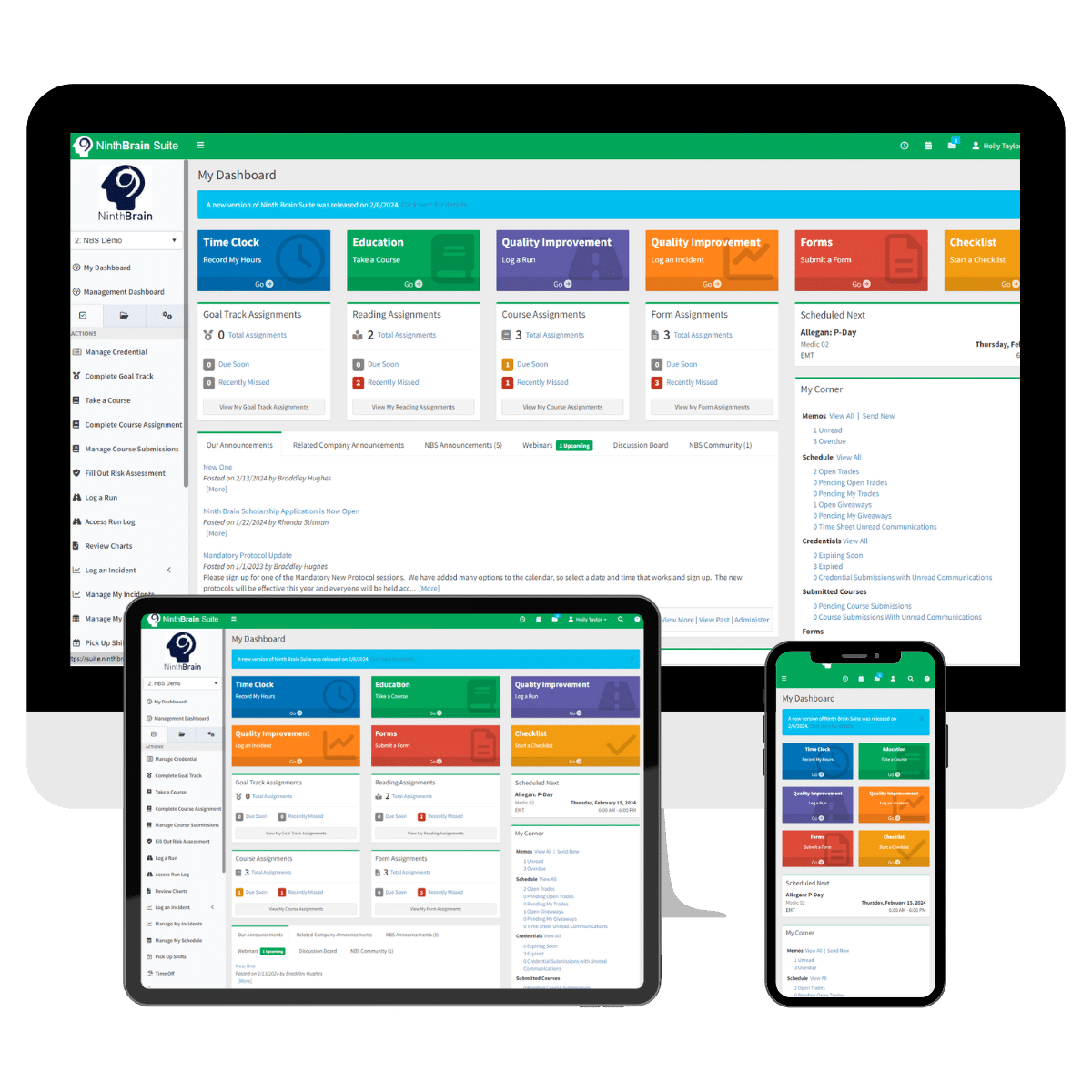
If your organization is experiencing paper overload, NinthBrain can help. Our team serves clients in a variety of front-facing industries, including EMS, air medical, pharmaceutical, dispatch, and fire sectors. However, our adaptable digital form and checklist builder tools can be invaluable to virtually any organization that needs access to custom digitized documents.
The NinthBrain form builder creates a seamless documentation workflow and even includes detailed data reports for analysis. With our powerful tools, you can create an unlimited number of forms and custom responses to meet the needs of your organization.
To learn more, we invite you to review our form builder page. You can also book a no-obligation demo.
Wondering if Ninth Brain is the right fit? Let’s Connect and Explore!