Incident management requires the use of emergency personnel and systems for real-time responses to critical situations.
The use of best practices is essential in emergency management. Having the tools and equipment to deal with unexpected events allows responders to save lives and deliver care when it’s needed. By using emergency medical services (EMS) software, first responders can manage all of the intricacies of their role.
What Is EMS Software?
EMS software is used by first responders to track important assets and ensure they’re providing the best care possible to victims when incidents occur. By taking advantage of modern computing capabilities, EMS software services make it easier for medical providers to manage daily tasks and reinforce best practices.
Deployments featuring EMS software can involve the use of a single application or a collection of applications curated to meet the demands of delivering critical care during emergency incidents. By connecting people with the right technologies, EMS software makes emergency management more practical and less complex.
Understanding the components of EMS software ensures you can take full advantage of the many features you can gain by using it in the field.
What Is EMS Software Used for?
EMS software is a powerful solution for emergency providers who want to simplify the management of their core services. The right EMS software allows medical personnel to collect field data, manage patients, and access documentation.
Modern EMS software is often used for:
- Billing
- Time management
- Accessing and updating patient records
- Equipment maintenance tracking
EMS software offers a variety of optimizations that first responders can use to take control of their workflows.
By bringing together information and technology, EMS software gives ambulance drivers, fire departments, and other first responders the ability to address their shortcomings by filling gaps in their training, communication, and support capabilities.
This flexibility makes EMS software a valuable solution for professionals working in all areas of emergency response.
5 Common Myths About EMS Software
As EMS software has become more popular, assumptions about its strengths have impeded good decision-making. While EMS software isn’t a magic solution that will immediately fix all of your problems, it provides some important advantages.
Users should be aware of many common myths about EMS software before deciding which is right for them:
Myth 1 — EMS Software Is Non-Compliant
Tracking and reporting on internal operations is an essential part of healthcare management. Many decision-makers don’t trust a software solution to generate reports, do audits, and ensure liabilities are addressed.
However, EMS software can be — and is — used by organizations throughout the industry to ensure HIPAA compliance and stay on top of regulations.
Myth 2 — EMS Software Is Hard to Use
Some emergency medical providers might be concerned that EMS software will only reduce response times because users have to get to know a whole new system.
However, modern EMS tools are simple to use and can improve the delivery of medical care by removing many barriers involved in collecting and communicating important emergency data.
Myth 3 — There’s No Need for Dedicated EMS Software
Many organizations avoid using any consolidating EMS software because they fear using a single repository for all their important information. This sole source could be a potential issue if the data were lost.
Modern EMS software provides real-time data storage, backup, and recovery capabilities that allow medical service providers to retain and process information. This automated retention allows for quality improvement audits and other historical documentation analyses to be carried out in a single, secure location.
Myth 4 — EMS Software Can’t be Integrated with Existing Systems
Most existing emergency response providers already have systems in place for dealing with their day-to-day tasks. Adding new solutions to existing infrastructure can make it difficult to maintain continuity of care.
EMS software easily integrates with exciting solutions, meaning their deployment won’t impact operations. With EMS, managers can mitigate failures and improve efficiencies by leveraging automated tools and services.
Myth 5 — Smaller Businesses Shouldn’t Use EMS Software
Many smaller businesses might assume that EMS software isn’t for them. Larger companies aren’t the only ones that can benefit from using EMS in the field. Smaller businesses can use streamlined communication channels, real-time support, and an actively maintained software ecosystem.
This setup eliminates overhead and makes it easier to provide care without failing to address important healthcare data.
Providing Better Care with EMS Software
Proper EMS software is an important tool that any modern company can take advantage of to improve care delivery. EMS software eases workloads and ensures the integrity of data. This approach is essential for medical providers who want to offer the best care to their patients.
Emergency care is complicated, and there are always new and unique incidents that need to be addressed.
Communicating emergencies, coordinating resources, and managing reports are all tasks that require a comprehensive solution. One that professionals can use to ease their workloads and eliminate waste. With EMS software, emergency personnel can meet these challenges head-on and continue their mission of saving lives.
A key element of effective scheduling is placing the right staff in the right place at the right time.
It may sound simple, but good EMS scheduling is an art. It requires a thorough understanding of your staff, how they perform their jobs and your community’s unique characteristics. And it requires a sophisticated approach to learning and analyzing data that allows you to predict future needs and plan accordingly.
EMS scheduling means more than simply filling the open shifts posted on a board. Effective scheduling demands precision placement of each EMS team member to ensure that you have enough coverage to meet demand, but not so much coverage that you are overstaffed.
Scheduling is an ongoing concern and challenge for every EMS organization, especially since call volumes, response times, and other factors can change daily based on weather, traffic conditions, or unexpected events, such as accidents or fires.
When you consider all of the factors that impact a schedule, it is easy to see why workforce management can be challenging. Here are some considerations:
- Staff availability and shift preferences
- Shift assignments based on workload demands
- Giving staff sufficient time off between shifts
- Overtime hours that comply with state and federal wage-and-hour regulations
The right tools can also help you track and manage overtime expenses to avoid unnecessary costs.
With high-quality programs designed to increase efficiency, you can reduce staff frustration and ensure that all team members are equipped to perform their roles while they’re on the job!
Maximize Your EMS Team with Workforce Scheduling
There are many benefits to using an EMS scheduler tool. For one, it makes the scheduling process much easier and less time-consuming. The automated software can also increase efficiency in terms of human resources allocation. It can help you create a schedule optimized for your team’s performance.
Using an EMS scheduler tool also helps you reduce costs by minimizing overtime payouts and last-minute schedule changes, which can be very expensive. There’s no need to use overtime hours when you already have an adequate number of employees working on the day shift.
A well-organized schedule allows your team to focus more on their duties and less on the logistics of their schedules.
Your employees will feel less stressed and more productive if they know exactly what to do and when.
Monitor Your Run Logs to Increase Accountability and Accuracy
A high-quality EMS scheduler tool can also help your crew members and supervisors to deal with your run logs. A comprehensive system should address flight, ground, drill, and non-patient logs, providing you with options to create forms completely from scratch or using high-quality templates.
Some tools even offer the ability to require all crew members to sign important documents like debriefs. Once forms are complete, alerts can be sent out to the proper individuals in the chain of command automatically.
Finally, a great EMS scheduler tool will allow you to add supplemental documentation to your run logs. This can help your crews to address all required steps in the run without spending a ton of time on collecting, filing, or completing required protocols. In turn, this saves supervisor manhours and time spent managing paperwork.
Track Overtime and Avoid Unnecessary Costs
A condition of employment for most first responders is working overtime when required. However, with budget cuts and an industry-wide effort to reduce overtime costs, more organizations are looking at optimizing their workforce to reduce unnecessary expenses.
Scheduling that’s not managed properly can impact revenue and cause customer service issues. Tracking and managing overtime expenses helps avoid unnecessary costs and control staffing levels to maximize revenue.
EMS scheduling software makes it easy to track and manage overtime expenses. With real-time visibility into your team’s availability, you can quickly see who is available for overtime or replacement shifts without disrupting your regular schedule.
Manually managed schedules often result in mistakes that lead to overtime. For example, if an employee calls out sick, you have to scramble to cover the shift, leading to costly overtime pay when someone volunteers or comes in on the short notice.
Final Thoughts
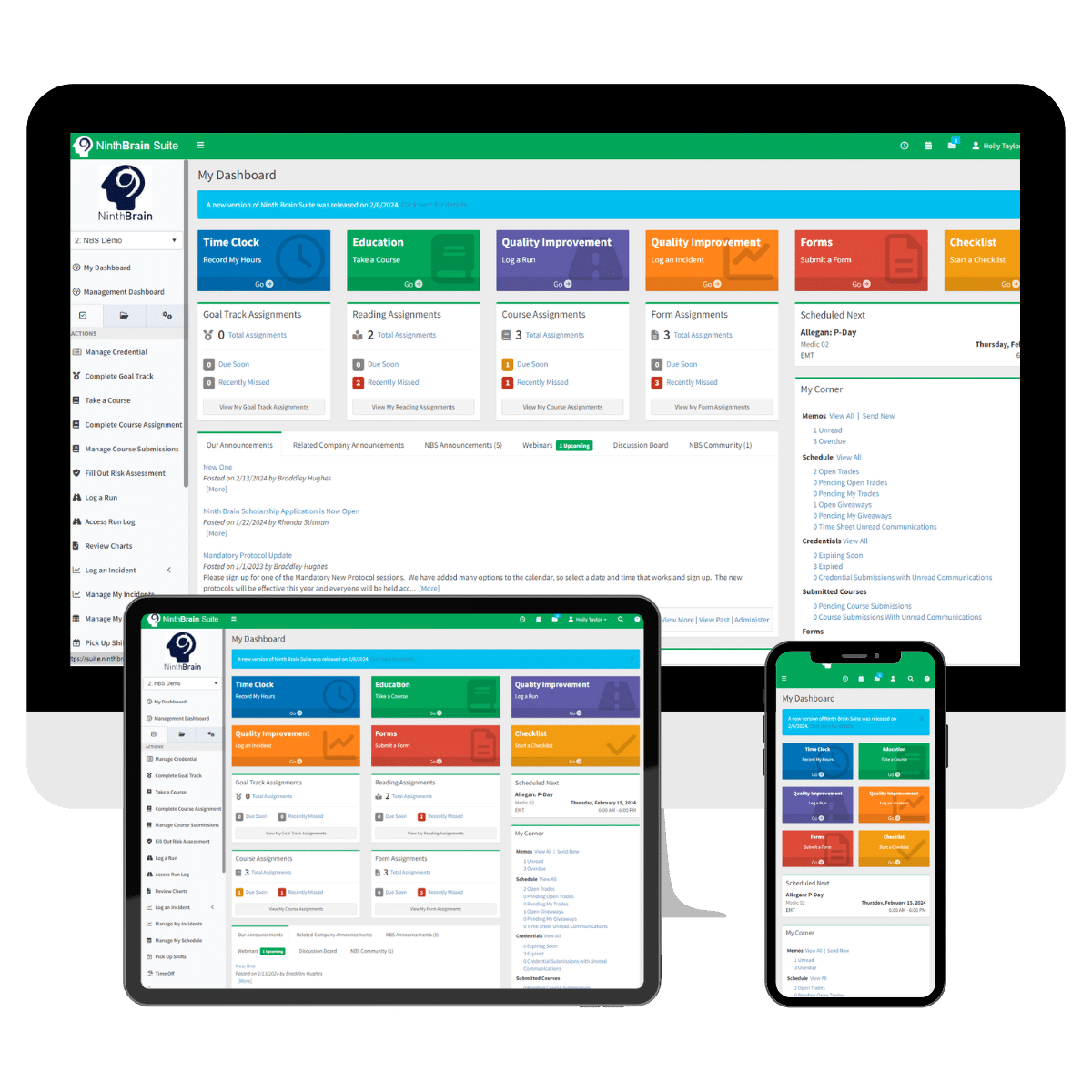
NinthBrain scheduling is a powerful software that efficiently places EMS teams at the right location, at the right time. The company’s workforce scheduling system helps emergency managers and directors predict labor costs and create more effective schedules through increased productivity and enhanced morale.
NinthBrain’s workforce scheduling software gives you the tools you need to be successful. No matter what organization you manage, tracking and managing overtime becomes more challenging as your team grows.
With NinthBrain EMS scheduling software, no matter how many shifts a day or week your employees work, you can monitor over time and ensure that all of your employees are scheduled appropriately to avoid headaches and unexpected costs that come with overtime.
BY ED MARASCO, MPM, CMTE, EMT-P (RET.)*
Long In The Tooth And Short On Plans
EMS is a relatively young profession and some of the challenges faced by our community today are “old world problems” for many of our peers around the healthcare and public safety sectors. As the early leaders in our professional approach their golden years, the question of future leadership looms large as we face substantial clinical, operational, and financial challenges. As a community, we pride ourselves on preparation and planning, along with the flexibility to adapt to changing circumstances. It is the nature of our work.
A key aspect of our preparation is succession planning. Identifying, recruiting, supporting, and grooming future leaders within our organizations is one of the most important aspects of our leadership responsibility. In a 2014 survey of organizational leaders by Deloitte Consulting, 86% of leaders believe leadership succession planning is “urgent” or “important”; however, only 14% believe they do it well. This discrepancy is concerning.
Key Benefits Of Effective Succession Planning
1. Stronger Culture
The proactive process of identifying and advancing leaders who embody the organization’s mission, vision, and values drives more alignment throughout the organization. We grow leaders who are aligned and at the same time, we send a clear message to those within our organization who may not be aligned with the mission, vision, and values.
2. More Diverse Group of Leaders
If we carry out an objective, unbiased identification process, we will likely end up with a more diverse and effective leadership team. It is important that we are deliberate in this approach.
3. Higher Quality Decisions Throughout the Organization
Working closely with staff and existing leaders to cultivate their leadership skills and engagement will promote better decision-making at various levels of the organization. Our team members make decisions every day on behalf of the organization. These decisions should reflect our values.
4. Retention Success
A deliberate approach to succession planning provides enhanced career development opportunities for emerging leaders driving greater engagement and retention. We know that deliberate career paths within organizations can be an effective retention tool. We should be overt about these paths.
5. Stability
Working to cultivate new leaders for the organization often results in stability and resiliency for the organization. Most EMS agencies are tied to specific communities. There is certainly an advantage to maintaining a team of well-respected, familiar leaders throughout the organization.
Why Is Succession Planning So Difficult?
1. Accountability
One of the biggest challenges is confusion over who has the primary responsibility to champion the process. Is this a Human Resources function? Is it an Executive Leadership function? Does it rest with each individual leader within the organization? To be successful, these questions must be answered deliberately by the organization.
2. Nerve-Wracking
The process of identifying and coaching one’s replacement is not always a comfortable process. It is human nature to desire some level of stability and predictability in life, especially when so many aspects of life around us are out of our control. However, ONE OF THE MOST IMPORTANT ROLES WE HAVE IS TO GROOM OUR REPLACEMENT.
3. Stability Concerns
Identifying and cultivating new leaders implies that change is coming. It is often difficult to battle the perception that working to develop new leaders necessarily means the prior leaders are “on their way out.” Some constituents may view this as a lack of stability within the organization. It is important to make it clear to the organization, at all levels, that we want to grow the talent we have in the organization and help every team member reach their full potential.
4. Time Horizon
Solid succession planning is something that truly evolves over time. It is a long-term exercise. Many leaders view the expectations and incentives as more short-term in their orientation. If a leader is focused on generating successes within the current year, how can they focus on initiatives that will yield no real measurable results until several years downstream? It requires a mindset that covers both short-term objectives and long-term goals for the organization.
Where Do We Go From Here?
Be selfish!! For many of us, there is an expectation that we will stay connected to the communities that we serve throughout our EMS careers. We may live there during our golden years; we may come back to visit family as we age, and we may still have loved ones who will be lifelong residents.
Our goal should be to entrust our EMS organization to the best and brightest as we approach the time in our lives when we may be more apt to use the services than to provide them. In these challenging times, it is important to understand that quality leadership is more important than ever before.
*Ed Marasco is QMC’s Vice-President of Business Development and a veteran healthcare provider and administrator with over 40 years of experience in emergency medical services, reimbursement, and consulting.
This blog post was originally posted on https://www.quickmedclaims.com/2021/02/succession-planning-why-bother/
Wondering if Ninth Brain is the right fit? Let’s Connect and Explore!