The Importance of End-to-End Compliance in EMS
In the fast-paced world of emergency medical services (EMS), the smallest oversight can lead to significant consequences. Imagine a vehicle breaks down in the middle of a transport, jeopardizing patient care and safety. Later, it is discovered that a required inspection hadn’t been completed. In another scenario, an EMS agency was sued after failing to document and address multiple patient care incidents; incidents that could have been avoided if patterns of issues were caught earlier.
These real-world scenarios highlight how crucial it is to have centralized systems in place — not just for tracking patient care incidents but also for ensuring vehicles are regularly inspected. By integrating these systems, EMS agencies can avoid costly oversights while improving operational efficiency, patient safety, and regulatory compliance.
The Role of Incident Tracking in EMS Compliance
Why Incident Reporting Matters
Properly reporting, tracking, and analyzing patient care incidents is not just good practice — it’s a legal and operational necessity. Without a system in place, EMS agencies risk missing critical trends in patient care that could lead to worse outcomes over time. One agency found this out the hard way when they were sued after failing to document and address multiple patient care incidents. This wasn’t just a costly legal battle; it was a failure to ensure patient safety.
Key Compliance Standards
Incident reporting isn’t just about avoiding lawsuits; it’s required by national standards. Organizations like the Commission on Accreditation of Ambulance Services (CAAS) and the Commission on Accreditation of Medical Transport Systems (CAMTS) set clear requirements for documenting and tracking incidents. For example, CAAS 201.06 and 202.05, as well as CAMTS 03.05, mandate a robust system for incident tracking.
Vehicle Inspections: A Vital Component of EMS Safety and Compliance
The Risk of Skipping Inspections
Remember that vehicle that suddenly broke down while transporting a critically ill patient? The investigation that followed revealed that a required inspection hadn’t been completed. The delay caused by this breakdown not only put the patient’s life at risk but also led to a formal state investigation into the agency’s practices. These incidents are rare, but most are avoidable if regular vehicle inspections are conducted.
Key Compliance Standards for Vehicle Safety
Vehicle safety is as critical as patient care. CAAS 203.03.02 requires that all equipment be checked regularly, and CAMTS 03.06.08 outlines the documentation requirements for vehicle inspections. These standards ensure that EMS vehicles are ready to respond and equipped to handle any emergency.
How Centralized Systems Bridge the Gap Between Incident Tracking and Vehicle Inspections
Operational Efficiency Through Integration
Having separate systems for incident tracking and vehicle inspections can be inefficient and error prone. By integrating both processes into a centralized system, EMS agencies can streamline their operations, reduce paperwork, and minimize human error. A unified platform eliminates the need to toggle between systems, saving time and improving data accuracy.
Improving Patient Safety and Reducing Risk
Both incident tracking and vehicle inspections play a key role in improving patient safety. A well-maintained vehicle and a well-documented incident history provide a solid foundation for delivering high-quality care.
The Future of EMS Compliance: Automating Processes and Improving Accountability
The Evolution of EMS Compliance Tools
Automation is transforming how EMS agencies manage compliance. As new standards emerge and expectations grow, tools like Ninth Brain will continue to play a vital role in reducing administrative workloads and improving compliance efforts. Automating both incident tracking and vehicle inspections allows EMS teams to focus on what matters most — delivering exceptional patient care.
Conclusion: Ensuring Comprehensive EMS Compliance
End-to-end compliance requires more than just checking off boxes — it requires a unified, proactive approach. With a centralized system for incident reporting and vehicle inspections, EMS agencies can avoid costly oversights, improve operational efficiency, and ensure patient safety.
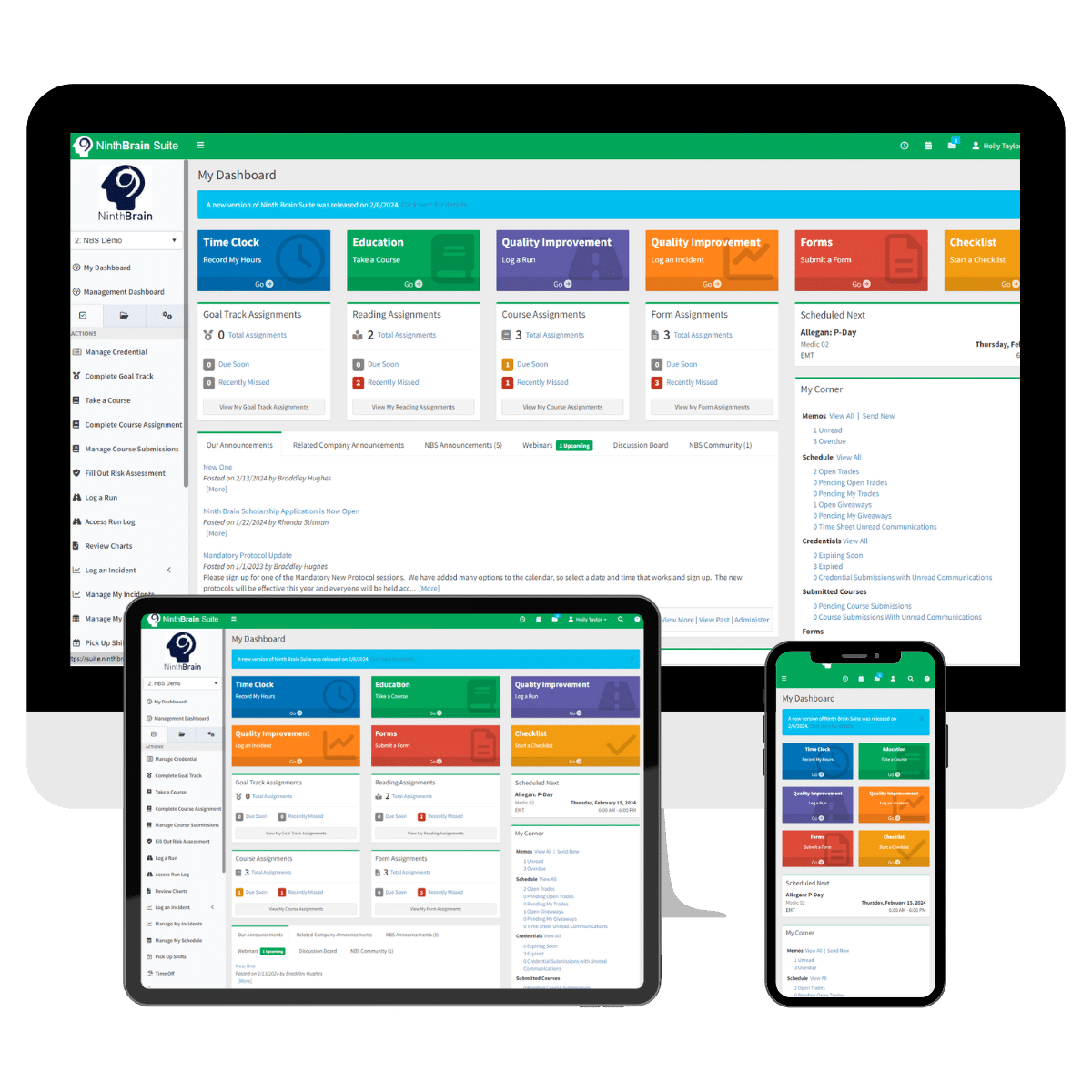
Ninth Brain offers an integrated, forward-looking solution that streamlines compliance across multiple areas of EMS operations. Its Incident Reporting system enables real-time reporting and analytics, providing a centralized platform for reviewing incidents, identifying trends, and taking corrective action, ensuring alignment with CAAS and CAMTS standards. Simultaneously, the platform automates the vehicle inspection process by attaching forms to shifts, supporting recurring inspections, and reducing manual workloads. This ensures that vehicles are consistently inspected and stocked, with detailed reporting available for high-level compliance checks or specific audits.
By centralizing all data, Ninth Brain allows EMS agencies to cross-reference information easily, such as connecting vehicle maintenance records to incident reports, improving operational efficiency and reducing risks. As the EMS industry continues to evolve, Ninth Brain remains committed to simplifying compliance and enhancing accountability for agencies everywhere.
Compliance Checklist Add-On: Is Your EMS Agency Ready for Full Compliance?
Use this checklist to assess your current compliance processes and identify areas for improvement:
Incident Tracking Compliance Checklist:
- Do you have a centralized system for reporting and tracking patient care incidents?
- Are incidents reviewed in real-time and addressed promptly?
- Are trends in patient care incidents regularly analyzed for corrective action?
- Does your incident reporting process align with CAAS 201.06 and 202.05?
- Does your incident reporting process align with CAMTS 03.05?
- Can you easily retrieve historical data on incident reports for audits?
Vehicle Inspection Compliance Checklist:
- Are vehicle inspection forms attached to shifts for regular inspections?
- Are vehicle inspections conducted and documented on time for every shift?
- Is there a recurring process for vehicle inspection forms to ensure regularity?
- Do your vehicle inspection reports meet CAAS 203.03.02 and CAMTS 03.06.08 requirements?
- Can administrators easily retrieve both current and previous versions of inspection forms with active dates?
- Are compliance gaps in vehicle inspections identified and addressed proactively?
If you’ve checked all the boxes, your EMS agency is well on its way to full compliance. If not, explore how Ninth Brain can help automate these processes and ensure no compliance detail is overlooked.
Click the button below to request a free demonstration of Ninth Brain today!

A key element of effective scheduling is placing the right staff in the right place at the right time.
It may sound simple, but good EMS scheduling is an art. It requires a thorough understanding of your staff, how they perform their jobs and your community’s unique characteristics. And it requires a sophisticated approach to learning and analyzing data that allows you to predict future needs and plan accordingly.
EMS scheduling means more than simply filling the open shifts posted on a board. Effective scheduling demands precision placement of each EMS team member to ensure that you have enough coverage to meet demand, but not so much coverage that you are overstaffed.
Scheduling is an ongoing concern and challenge for every EMS organization, especially since call volumes, response times, and other factors can change daily based on weather, traffic conditions, or unexpected events, such as accidents or fires.
When you consider all of the factors that impact a schedule, it is easy to see why workforce management can be challenging. Here are some considerations:
- Staff availability and shift preferences
- Shift assignments based on workload demands
- Giving staff sufficient time off between shifts
- Overtime hours that comply with state and federal wage-and-hour regulations
The right tools can also help you track and manage overtime expenses to avoid unnecessary costs.
With high-quality programs designed to increase efficiency, you can reduce staff frustration and ensure that all team members are equipped to perform their roles while they’re on the job!
Maximize Your EMS Team with Workforce Scheduling
There are many benefits to using an EMS scheduler tool. For one, it makes the scheduling process much easier and less time-consuming. The automated software can also increase efficiency in terms of human resources allocation. It can help you create a schedule optimized for your team’s performance.
Using an EMS scheduler tool also helps you reduce costs by minimizing overtime payouts and last-minute schedule changes, which can be very expensive. There’s no need to use overtime hours when you already have an adequate number of employees working on the day shift.
A well-organized schedule allows your team to focus more on their duties and less on the logistics of their schedules.
Your employees will feel less stressed and more productive if they know exactly what to do and when.
Monitor Your Run Logs to Increase Accountability and Accuracy
A high-quality EMS scheduler tool can also help your crew members and supervisors to deal with your run logs. A comprehensive system should address flight, ground, drill, and non-patient logs, providing you with options to create forms completely from scratch or using high-quality templates.
Some tools even offer the ability to require all crew members to sign important documents like debriefs. Once forms are complete, alerts can be sent out to the proper individuals in the chain of command automatically.
Finally, a great EMS scheduler tool will allow you to add supplemental documentation to your run logs. This can help your crews to address all required steps in the run without spending a ton of time on collecting, filing, or completing required protocols. In turn, this saves supervisor manhours and time spent managing paperwork.
Track Overtime and Avoid Unnecessary Costs
A condition of employment for most first responders is working overtime when required. However, with budget cuts and an industry-wide effort to reduce overtime costs, more organizations are looking at optimizing their workforce to reduce unnecessary expenses.
Scheduling that’s not managed properly can impact revenue and cause customer service issues. Tracking and managing overtime expenses helps avoid unnecessary costs and control staffing levels to maximize revenue.
EMS scheduling software makes it easy to track and manage overtime expenses. With real-time visibility into your team’s availability, you can quickly see who is available for overtime or replacement shifts without disrupting your regular schedule.
Manually managed schedules often result in mistakes that lead to overtime. For example, if an employee calls out sick, you have to scramble to cover the shift, leading to costly overtime pay when someone volunteers or comes in on the short notice.
Final Thoughts
NinthBrain scheduling is a powerful software that efficiently places EMS teams at the right location, at the right time. The company’s workforce scheduling system helps emergency managers and directors predict labor costs and create more effective schedules through increased productivity and enhanced morale.
NinthBrain’s workforce scheduling software gives you the tools you need to be successful. No matter what organization you manage, tracking and managing overtime becomes more challenging as your team grows.
With NinthBrain EMS scheduling software, no matter how many shifts a day or week your employees work, you can monitor over time and ensure that all of your employees are scheduled appropriately to avoid headaches and unexpected costs that come with overtime.
Wondering if Ninth Brain is the right fit? Let’s Connect and Explore!