First responders have many things to consider when navigating complicated situations. Monitoring and responding to potential threats in real time is essential for delivering quality care and saving lives.
Knowing what to expect when responding to medical situations is especially important for EMS teams since they’re often the first to arrive. Understanding potential threats and implementing systems for dealing with them will improve the likelihood of success during emergency situations.
With good risk mitigation practices, organizations can coordinate with their teams to integrate best practices into the job, improving compliance and eliminating uncertainties.
What Is Risk Mitigation?
No matter what industry you’re in, there are certain risks you want to avoid. In emergency response, there are often concerns associated with scheduling, accidents, and investigations that must be properly managed.
Organizations working in fire, medical, dispatch, and pharmaceuticals should have a framework to reduce the likelihood of risk. These risk mitigation practices offer important human, financial, and legal safeguards that allow teams to operate without breaching standards of practice.
Why Is Risk Mitigation Important for EMS Teams?
Risk mitigation is crucial for EMS teams since it allows them to reduce loss of life and harm while operating in the field. Eliminating security and safety risks helps departments protect first responders and themselves from making common mistakes.
In many cases, risk mitigation is a moral choice that companies make concerning those who might be impacted by their actions. Because they operate in a high-risk environment, healthcare workers should be especially careful to learn risk mitigation techniques and practice them regularly.
How Should EMS Teams Perform Risk Mitigation?
Risk mitigation isn’t the same for every organization. Different fields and industries will need to approach their risk mitigation strategies with care and stick to established best practices to ensure that they’re getting the most out of their approach.
EMS teams in particular need to understand the procedures required to maintain compliance at all times. Some key risk mitigation techniques include:
1. Having Preformulated Strategies in Place
The best risk mitigation practices are those that have been put in place beforehand, allowing companies and their staff to get on top of them before operating in the field.
For EMS teams, this means knowing how to eliminate risks that could put themselves or others in harm’s way while carefully documenting every step of the process.
Prioritizing the biggest and most common risks is a good place to start; you can add more from there. Provide ongoing education to workers so they can remain up-to-date about current best practices and any changes that have taken place.
2. Assessing the Situation
Knowing how to stay calm under pressure and consider your best options is essential for any EMS provider. Teams need to be able to quickly grasp the nature and magnitude of an emergency and take the necessary steps to mitigate existing risks.
If you want to ensure that EMS teams know what to do when they perceive a risk, schedule training drills where they can work together to act out a problem and take the necessary steps to manage the situation. With enough practice, they’ll be able to remain calm and properly assess the situation when things get complicated.
3. Taking Steps to Reduce Risk
Once they’ve recognized a risk, EMS teams need to have discrete steps they can follow. Organizations should document every step of the prescribed plan of action so they can determine liabilities and adjust as needed.
At this point, EMS teams should have a solid understanding of specific risk mitigation techniques they can use in the real world. With a well-informed staff and clear directions, it will be much easier for them to avoid risk and take action to successfully resolve various emergency situations.
4. Providing Appropriate Care
Once EMS teams have taken the necessary steps to mitigate risks to themselves and others, they can proceed to provide care to those who need it. Responders should be careful to follow proper procedures at all times to ensure that they aren’t in violation of any organization or industry policies.
Caregivers should be mindful of their own well-being by eating and resting at regular intervals and communicating any deficiencies to their superiors.
Understanding Risks Is Essential for Improved EMS Response
Risks can present themselves in any situation, and it’s important to be ready with the proper response. EMS teams regularly deal with risks under pressure, making it especially important to have the proper knowledge and training.
Inadequate risk mitigation techniques can potentially put teams and others in danger, making it harder to carry out an efficient response. Risk mitigation is important for EMS teams because it gives them a way to provide care while maintaining strict quality standards that allow them to do their jobs without disruption.
When dealing with online services, companies must have strict policies about their team’s knowledge and training in place, especially for teams in the emergency medical services (EMS) field. Establishing such policies, though, is only possible with the aid of third-party entities that provide leaders and workers alike with the necessary education.
Keeping track of employee credentials provides leaders with a clear picture of who has the proper knowledge and where to look if things go wrong. However, should team members be carrying expired credentials, it’s only a matter of time before something bad happens, and so many things can go south as a result.
Whether aiding in a health emergency or responding to a domestic call, EMS providers need to be prepared to deal with whatever comes their way, and a lack of proper credentials can lead to internal issues, making it harder to complete tasks, hire new personnel, and budget effectively.
Why Are Credentials Important For Ex?
Emergency responders are required to have specific technical skills that allow them to provide medical care, safely operate emergency equipment, and communicate with those in need. Furthermore, EMS teams need to be properly certified to ensure they have the knowledge and expertise necessary to perform their assigned tasks without incident.
Credentials provide a source of verification that organizations can use to make sure team members have been vetted by reliable institutions. They also provide added security for the organization, as they can make sure that only properly skilled workers are operating in the field. Credentialed workers are trained to log information properly, complete reports, and verify data so that they aren’t operating on false assumptions.
What Happens When Out-of-Date Credentials Go Unchecked?
Emergency situations require adequate training and preparation, making it vital for everyone to be on the same page regarding what they do and don’t know. Failing to check for outdated credentials can have drastic consequences for EMS organizations. Accidents, injuries, and death can all occur if individuals don’t know what they’re doing. The organization can also be penalized by regulatory agencies and have monies returned by insurance or medicare if a provider has improper credentials and billing happens.
That’s why EMS organizations need policies that clearly communicate what credentials are needed for what roles. Everyone needs to pull their weight on an EMS team, so keeping up with changes in the field, learning proper operational procedures, and reducing the potential for compliance issues are just a few of the numerous reasons EMS providers need to have the proper credentials.
It’s Harder for Teams to Navigate Change
Emergency services are constantly evolving to adapt to existing and new circumstances, so EMS credentials must be updated regularly to ensure that emergency responders understand the latest changes in the field. It’s hard for anyone to catch up and keep up with industry practices once they fall behind, and a lack of preparation can impact the entire team.
They May Lack the Necessary Skills
EMS providers must keep up with their on-the-job skills to ensure they’re operating efficiently. Doing so can save time, money, and lives, which makes it essential for employers to keep track of their teams. Developing the proper abilities takes time, though, and failing to update credentials can leave gaps or deficiencies that are difficult to overcome.
Credentialing allows emergency responders to test their knowledge and gain some confidence or see where they need to improve. Taking and passing the requisite coursework also allows EMS organizations to ensure their employees have all the appropriate skills for the job.
You May Be Held Liable for Mistakes
Organizations that allow EMS teams to operate without the proper credentials can be held liable if something goes wrong in the field. Improper care can have wide-reaching consequences for EMS organizations, and legal actions, such as fines, can be levied for negligence claims. Depending on the severity of the claim, the company could even face closure.
That said, it’s up to EMS organizations to ensure their team members are up to the tasks they’re given. Personnel should have the certification for each role they’re assigned, and they shouldn’t be handed responsibilities above their level of expertise. Ensuring everybody is properly credentialed will allow EMS organizations to deliver quality care and operate without disruption.
Take the Proper Steps to Ensure Safe Operations
EMS organizations are people’s lifeline against perilous hazards, accidents, and natural disasters, so if responders aren’t properly credentialed, it can put lives at risk. Providers should have systems in place to ensure their teams are properly credentialed so they don’t risk liability or allow other incidents to occur.
Safely operating on the scene of an emergency should be second nature to EMS providers, but some provide misinformation about credentials to their employers, and others forget to stay updated. Educating yourself and your employees and keeping up-to-date with credentials will create a workforce everyone can count on.
Tracking and managing performance is essential for organizations and teams that want to be at their best, and in the field of Emergency Medical Services (EMS), where success or failure can have real-world consequences, it is a concept that is especially important.
Understanding which factors are most important to track isn’t always so clear, but through the use and analysis of key performance indicators (KPIs), the ability to spot any deficiencies in operations and adjust accordingly, all in a short amount of time, becomes much easier.
KPIs are great for seeing where you are in relation to your long-term performance goals, and they provide a baseline for measuring criteria such as productivity, management strategies, and financial well-being.
Why Should EMS Providers Track KPI?
KPIs have become integral to the core operations of many EMS organizations. After all, you can’t know where you’re going unless you have a good idea of where you’re coming from.
For EMS services, the ability to succeed in difficult situations and enhance their growth is fundamentally determined by quantifiable results that can be looked at and improved. Knowing which KPIs to look at, therefore, will allow them to meet their strict standards of practice.
In order to make their strategic visions a reality, however, service providers must implement a clear plan of action for their employees to follow to eliminate unwanted behaviors and missed opportunities.
What Are the Most Important KPIs for EMS Providers?
EMS providers need to understand what to look out for when tracking and managing their day-to-day operations. KPIs offer a clear picture of the organization’s habits and expectations so that leaders can make improvements from the top down.
These developments require considerable effort on the part of both organizations and their workers, but nothing will change without a solid management structure that accounts for key areas of concern. These elements should be regularly assessed to ensure public safety.
1. Time to Response
The time it takes for EMS providers to respond to a scene has a huge impact on their ability to provide care, offer assistance during emergency events, and prevent further harm. As such, arriving as soon as possible can save lives, making it an essential metric to track for performance evaluation.
Response times are calculated based on how long it takes for callers to see a response. Measuring and improving this KPI is essential for organizations that want to meet the demands of the public.
2. Response Management
No matter how quickly you arrive on a scene, if you don’t provide good service, your efforts are meaningless. For EMS teams, “good service” is defined by their capability to recover from incidents, and delivering the best service means understanding evolving situations and acting accordingly.
EMS organizations must be able to control the scene, answer questions, and provide aid to the best of their ability. The capacity to answer questions and provide preparation for potential disasters are also important performance indicators.
3. Resource Usage
A more quantifiable performance indicator is the number of resources used while preparing for and responding to incidents, which can be associated with anything from personnel to equipment maintenance.
Since EMS organizations have limited resources, they need to enforce strict methodologies for tracking and managing costs. Understanding KPIs regarding resource usage should be done regularly to ensure that operations run smoothly and efficiently.
4. Personal Safety
The last thing EMS organizations want is for their emergency responders to get injured while on the job. Unfortunately, it does happen, but it should still be a rare occurrence, and organizations that see it too often need to consider adjusting their core practices.
Personal safety can be addressed through training, providing PPE, and investing in updated equipment. For many organizations, personal safety comes down to having proper support systems in place for workers to communicate their problems and address any deficiencies that exist.
5. Mortality Rates
Saving lives is, of course, the reason EMS services exist, but regularly failing to do so can be a huge red flag that there’s something wrong at the policy level of these organizations. Tracking mortality rates for EMS services can give you a good idea of how well they’re doing toward fulfilling their obligations.
EMS providers, firefighters, healthcare workers, and police officers all face incredibly complex situations on a daily basis, so having the tools and knowledge to unravel everything and put it into context will allow them to save more lives and properly serve the public.
Stay on Track with the Most Common EMS KPIs
EMS services need to be as consistent as possible in order to provide the best care and save the most lives. With the right solutions, you can use scheduling software, logging, risk assessments, and other powerful tools to see which performance metrics are most important, set realistic goals, and track progress toward reaching them.
For organizations that are charged with upholding public security and safety, simply knowing which metrics to look at isn’t enough. Those in the industry who want to provide fast, passionate, and effective care have many options available for ensuring they’re up to quality standards, meeting their objectives, and protecting more people from harm.
EMS personnel, law enforcement officers, and firefighters share a long-standing tradition of trading quips and witticisms on shared scenes. Referring to firefighters as “hose draggers,” a police officer as a “flatfoot,” or EMS personnel as “taxi drivers” is usually done in jest. However, a small percentage of the population actually view EMTs and paramedics as little more than “ambulance drivers.”
In order to show our appreciation for the dedicated individuals that provide emergency medical care to millions of people every year, we wanted to discuss why EMS staff are much more than just drivers. Our hope is that this article sheds some light on the emergency medical services profession and the talented people behind the wheel of those “hospital taxis.”
Becoming an Emergency Medical Technician Requires Dedication
Those who are not familiar with emergency medical services may not realize that there are various classes of service providers aboard an ambulance. Of those, EMTs or emergency medical technicians are considered to be entry-level providers. Despite this designation, becoming an EMT requires a significant amount of training.
While the exact number of hours needed to become an EMT vary from state to state, these courses may take as long as 16 weeks to complete. After completing an approved course, attendees must pass the National Registry of Emergency Medical Technicians computer exam. They must also pass the NREMT practical skills exam.
EMTs are invaluable to the EMS profession and the communities that they serve. According to data collected by the National Highway Traffic Safety Administration’s Office of EMS, EMTs care for roughly 25 to 30 million U.S. residents every year.
EMS Medics Are Highly Trained
In addition to EMTs, ambulance crews often include individuals who have become certified as paramedics, often known as “medics” for short.
Paramedics have to complete hundreds of hours of clinical and academic training. These training courses are extremely rigorous and designed to equip paramedics with the skills necessary to perform advanced lifesaving measures, such as intubating patients and administering IV medications.
Paramedics are capable of providing a higher level of care than EMTs, due to their advanced medical training. While EMTs, engineers, or other individuals typically drive ambulances, paramedics may also be required to operate emergency medical vehicles. This is particularly likely when discussing ALS or advanced life support ambulance crews, as each member of the team can be certified as a paramedic.
Together, paramedics and EMTs provide essential front-line care to individuals who are suffering from acute injuries, life-threatening illnesses, and other adverse health events.
Operating an ambulance and shuttling patients to the hospital is a very small component of an EMS professional’s responsibilities!
EMS Staff Are Poised Under Pressure
On every call, EMS staff are placed under extreme amounts of pressure. They must address the needs of the patient while simultaneously contending with environmental hazards, psychological stress, and concerned family members. Successfully doing this requires EMTs and paramedics to exhibit significant poise and composure in the midst of utter chaos.
Oftentimes, EMS personnel must drop off a patient, clean their rig, and proceed to the next call before they have a moment to process what they just observed at the scene of the past incident. An EMS crew may have to resuscitate a small child, respond to a severe traffic crash, and treat a gunshot victim all in a single night. These selfless professionals are expected to handle all of this stress while continuing to provide exceptional care to every patient they encounter.
Medics and EMTs Provide Essential Community Services
If medics and EMTs were simply tasked with shuttling patients to the hospital, millions of lives would be lost every single year. Fortunately for all of us and the community at large, these individuals do much more than simply drive ambulances — they also make split-second decisions in order to improve patient outcomes and provide life-saving care.
Medics and EMTs lay the foundation for more advanced care at dedicated treatment facilities, such as hospitals and freestanding emergency rooms. These professionals assess patients while on scene and continue to monitor them in transit.
Upon arrival at a care facility, they provide receiving staff members with detailed information about the patient’s condition so that physicians can determine the next appropriate action.
Emergency Medical Services Professionals Care About Patient Outcomes
Finally, EMS professionals across the nation continue to show up for work day in and day out because they truly care about their patients. They pour their hearts and souls into every call, just to save the life of complete strangers.
This unparalleled commitment to serving others and saving lives is what makes EMS professionals so much more than just ambulance drivers.
All EMS operations carry some inherent degree of risk. Your responders must have the skills to assess risk while in the field correctly. In addition to these skills, your responders must be willing to implement risk assessment for every run. To skip the risk assessment step is a drastic breach of protocol that will leave both your responders and patients less safe.
How Risk Assessments Benefit Your Organization?
An effective risk management plan makes your organization safer for everyone involved, both your staff and your patients. The best risk assessment strategies are broken down into several key steps, all of them essential.
The first is identifying the risk. This critical first step entails proactively finding risk exposures. Carefully evaluate how departments function and what they are likely to encounter based on precedent. An effective EMS management system can streamline the process by managing checklists and incident reports, saving time, and making efforts more thorough.
Next, you must quantify risks. For example, how likely is a threat to occur, and how severe will its impact be? Based on these evaluations, your team can know how extensive your mitigation efforts must be to protect against that risk.
Understanding the impact and likelihood of risks allows your team to prioritize and distribute resources as appropriate. That is a complex task, and it will involve the cooperation of multiple departments and notifications and protocols for many of your staff. An EMS management system can make these administrative tasks much more straightforward.
Mitigating Risk Through Assessments
Risk assessments are a core element of exposure avoidance. The simple fact of the matter is that a defined and controlled approach results in fewer incidents and less severity when they do occur. The lack of training and equipment that would have been determined necessary during an assessment will leave your responders without the tools they need in the field.
Another critical function of risk assessment is to allow your organization to implement segregation of loss exposures. These measures are preventative, ensuring that exposure leads to minimal damage.
The risk assessment identifies how risks to one individual or department can affect others and plans for those contingencies. Without this planning, your organization can find itself going without key supplies if a sole supplier fails to deliver or missing a critical skill in the field because the only trained responder isn’t on that shift.
Risk assessment can help your team identify situations where external help is required. When you have a prior understanding of when it is appropriate or necessary to call in another organization to handle a problem, you can ensure that your staff and responders don’t end up in situations they are not trained to handle.
Overall, skipping risk assessment will open your organization up to potential disasters on all fronts. There is a reason that risk assessment has become a fundamental part of EMS operations everywhere.
Our EMS management systems can streamline your risk assessment procedures and documentation. To find out more, contact sales@ninthbrain.com to see what we can do for you.
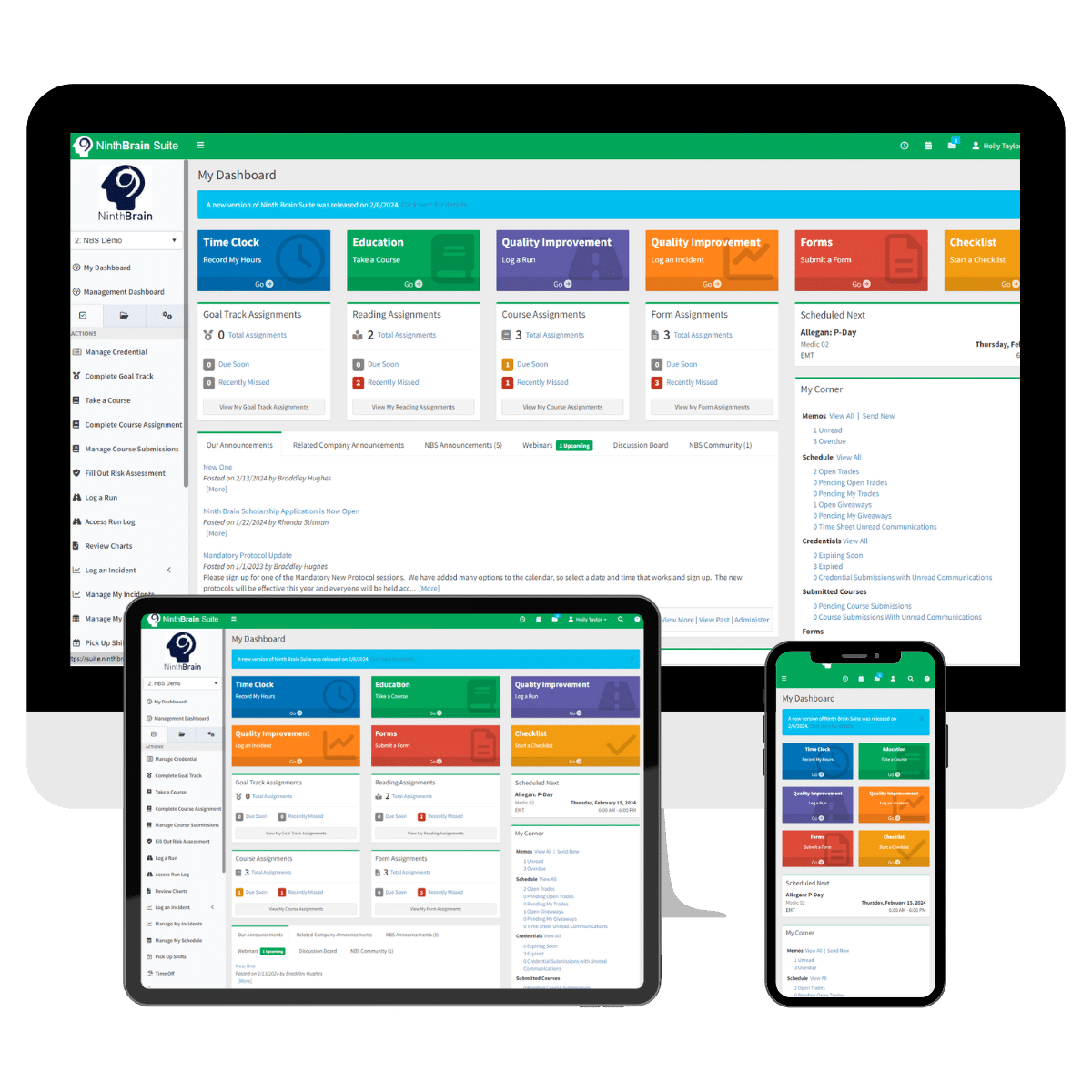
Wondering if Ninth Brain is the right fit? Let’s Connect and Explore!