Operational Risk Assessments for First Responders
Air medical flight crews and ground emergency units face operational hazards including severe weather, nighttime landing zones, crew fatigue, complex patient handling, and unfamiliar terrain. Relying on mental checklists or paper forms can introduce rushed decisions and subjective bias.
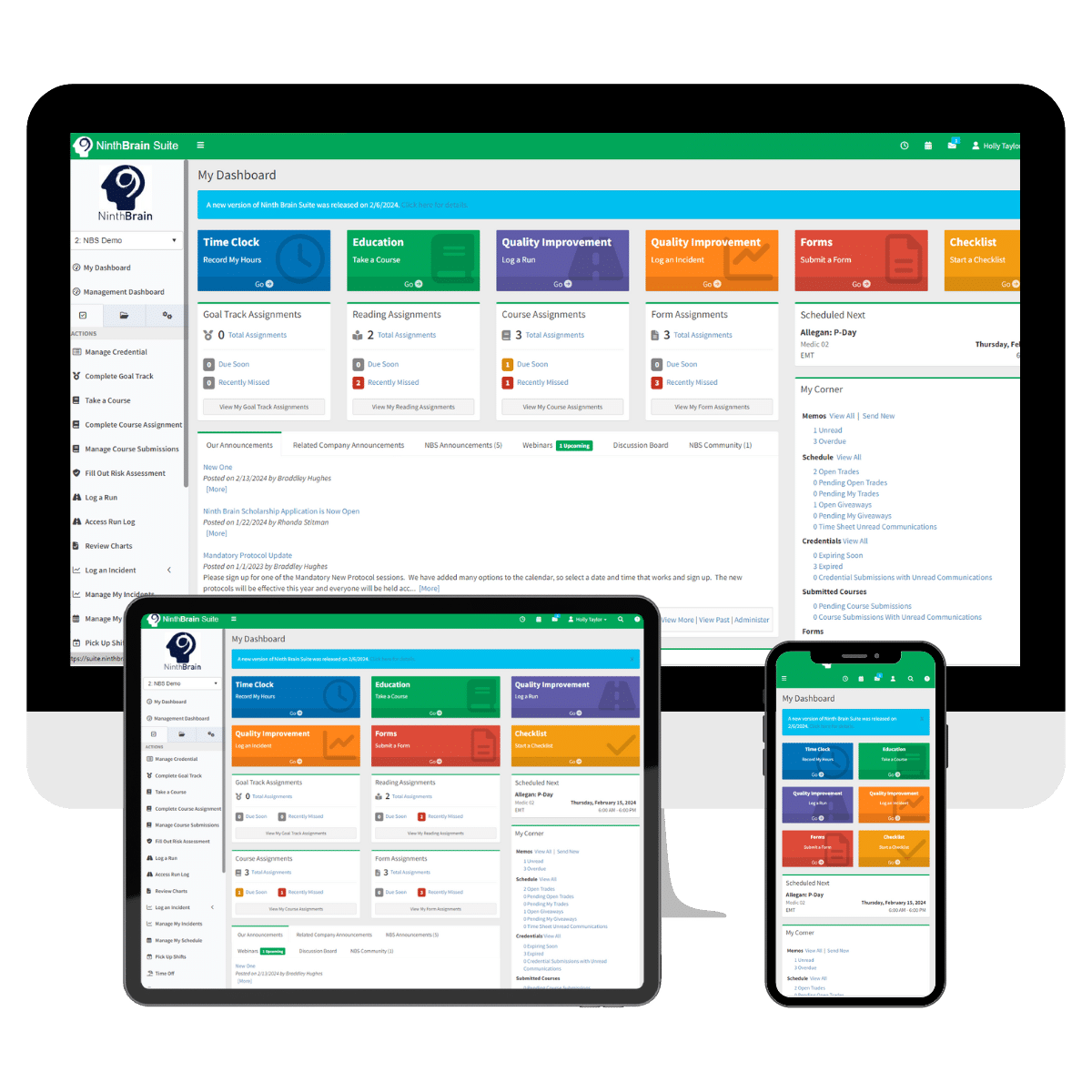
Ninth Brain’s digital risk assessment tool standardizes operational risk assessments across the entire mission lifecycle through an objective, quantifiable scoring system. Crews can complete evaluations from smartphones, tablets, laptops, or station terminals before, during, and after transport operations. Weighted environmental, operational, crew fatigue, clinical, and mission-specific factors generate composite risk scores, while elevated scores automatically trigger supervisor reviews or required safety officer sign-offs.
Integrated within the Ninth Brain EMS software ecosystem, safety matrices provide visibility across crew schedules and operational records.
Key Benefits
- Standardized, weighted hazard scoring
- Automatic alerts when risk thresholds exceed limits
- Real-time tracking of crew fatigue and weather factors
- Documented audit trails for CAMTS and FAA SMS compliance
- Historical safety data analysis to identify recurring hazards
Built specifically for pre-hospital transport and emergency healthcare, Ninth Brain supports evolving accreditation standards through ongoing implementation and software updates. Our proactive safety tools help EMS agencies reduce preventable hazards and uphold safety standards.
Ready to standardize your risk assessments? Request a personalized demo today.

Frequently Asked Questions
QI Risk Assessment
Yes. You can control access by job title, allowing you to tailor assessments to specific roles (e.g., dispatch vs. field crew).
Yes. You can choose whether to display scores during completion, helping users focus on accurate responses without bias.
Yes. Assessments are fully customizable, allowing you to create relevant question sets based on role, location, or scenario.
Yes. Automated alerts can notify designated administrators when assessment scores exceed established thresholds. This allows your team to quickly review the assessment, implement control measures, and document actions taken to reduce risk and improve safety outcomes.