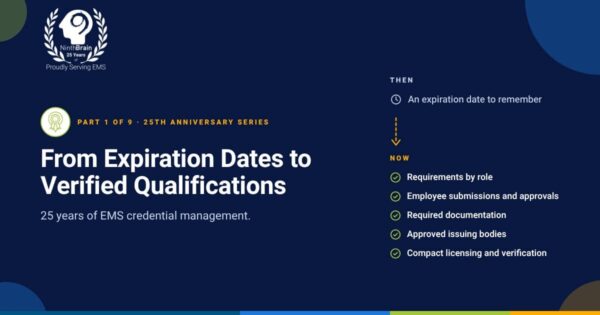
From Expiration Dates to Verified Qualifications: 25 Years of EMS Credential Management
In November 2001, development began on the software that would become Ninth Brain. One of its first jobs was easy to describe: keep track of employee licenses and warn administrators before they expired.
Twenty-five years later, that job looks very different. A single EMS credential can now come with a required issuing body, documentation that has to be on file, a National EMS ID, and authorization that crosses state lines through a compact. Knowing when a credential expires still matters. It just isn’t the whole job anymore.
This is the story of how credential management in Ninth Brain grew from an expiration date into a clearer answer to a bigger question: does the right person have the right qualification for the job?
2001–2002: Getting expiration dates out of the binder
Before software, credential tracking usually meant binders, spreadsheets, and someone remembering to check them. The original plan for Virtual Clinical Manager included tracking employee licenses and alerting administrators as expiration dates approached.
The first version launched in April 2002 with basic license tracking and “ticklers,” our original name for alerts. Continuing Education tools let organizations track employee certifications and licenses in one place. For many agencies, simply knowing what was about to expire was a big step forward.
But EMS credential management didn’t stay simple. And neither did Ninth Brain.
2005: A new question, “Is this person qualified for the role?”
By 2005, credential management had grown well beyond a list of dates. Organizations could set required certifications by job title, report on National Registry certifications, and track state certification and license requirements.
That changed the question.
It was no longer only “When does this license expire?” It was also “Does this employee have what they need for their role?”
2014: Credentials and education come together
Version 3.0 brought Credentials and Education together. The qualifications an employee needs and the education used to earn or maintain them naturally belong side by side, and now they lived that way in the platform too.
2021–2022: The credential record becomes a shared workflow
As requirements grew more complex, keeping records accurate took more than storing dates.
In 2021, administrators gained the ability to upload the front and back of a credential card and merge them into a single PDF. Organizations could also require credential numbers for the credentials they tracked.
In 2022 came a bigger shift: participation without giving up oversight. With the new credential approval workflow, employees could submit their own credentials for administrator review. The work of keeping records current no longer sat with one administrator, and the organization still decided what was approved. That same year, National EMS ID was added to individual credential records, and missing required credentials were highlighted so employees and administrators could see gaps at a glance.
2024: Holding the record to a higher standard
But a credential is more than a name and an expiration date. Which organization issued it? Is supporting documentation required? Does that issuing organization meet the employer’s requirements?
Ninth Brain kept adding that context.
In 2024, organizations could require administrators to attach documentation whenever a credential was added or recertified. They could also specify which issuing bodies were acceptable for ACLS, BLS, and PALS, so a card from the wrong source no longer counted.
2026: Keeping pace with how EMS licensing works today
Credentialing itself keeps changing, and so does Ninth Brain. This year added support for EMS Compact and Nursing Compact credentials, making multi-state authorization visible inside required-credential workflows.
Required credentials aren’t just about job titles. They can also depend on location, so employees with the same job title may need different credentials depending on where they work. The rules behind requirements got easier to maintain, too. When an organization’s requirements change, administrators can now edit an existing Required Credentials rule instead of deleting it and building it again.
Where credentials meet verification
A credential record is only as good as the information in it. That’s why Ninth Brain’s credential tools increasingly work alongside Verification Monitoring, which checks credential data against primary sources and flags mismatches in numbers and expiration dates. That story has its own chapter later in this series.
The destination was never just a digital filing cabinet
When Ninth Brain started tracking credentials, moving information out of paper files and into an online system was valuable on its own. Today, the expectations are different.
EMS organizations need to know what credentials an employee has, what they’re required to have, whether documentation supports the record, where a credential came from, when action is required, and whether changing requirements affect an employee’s qualifications.
That’s why credential management in Ninth Brain has moved from storing and tracking dates, to managing role-based requirements, to connecting employees, documentation, and approvals, and increasingly toward verification. The goal throughout: less manual follow-up, better visibility for administrators and employees, and more complete, defensible credential records.
That evolution didn’t happen all at once. It happened through 25 years of working alongside EMS organizations and responding as their needs changed.
The technology has changed. The requirements have changed. The way EMS organizations work has changed.
We’ve spent 25 years listening, learning, building, and evolving with EMS. And we’re still doing it.
Next in the series: how Forms grew from a document repository into connected workflows. Request a demo to see credential management in Ninth Brain today.