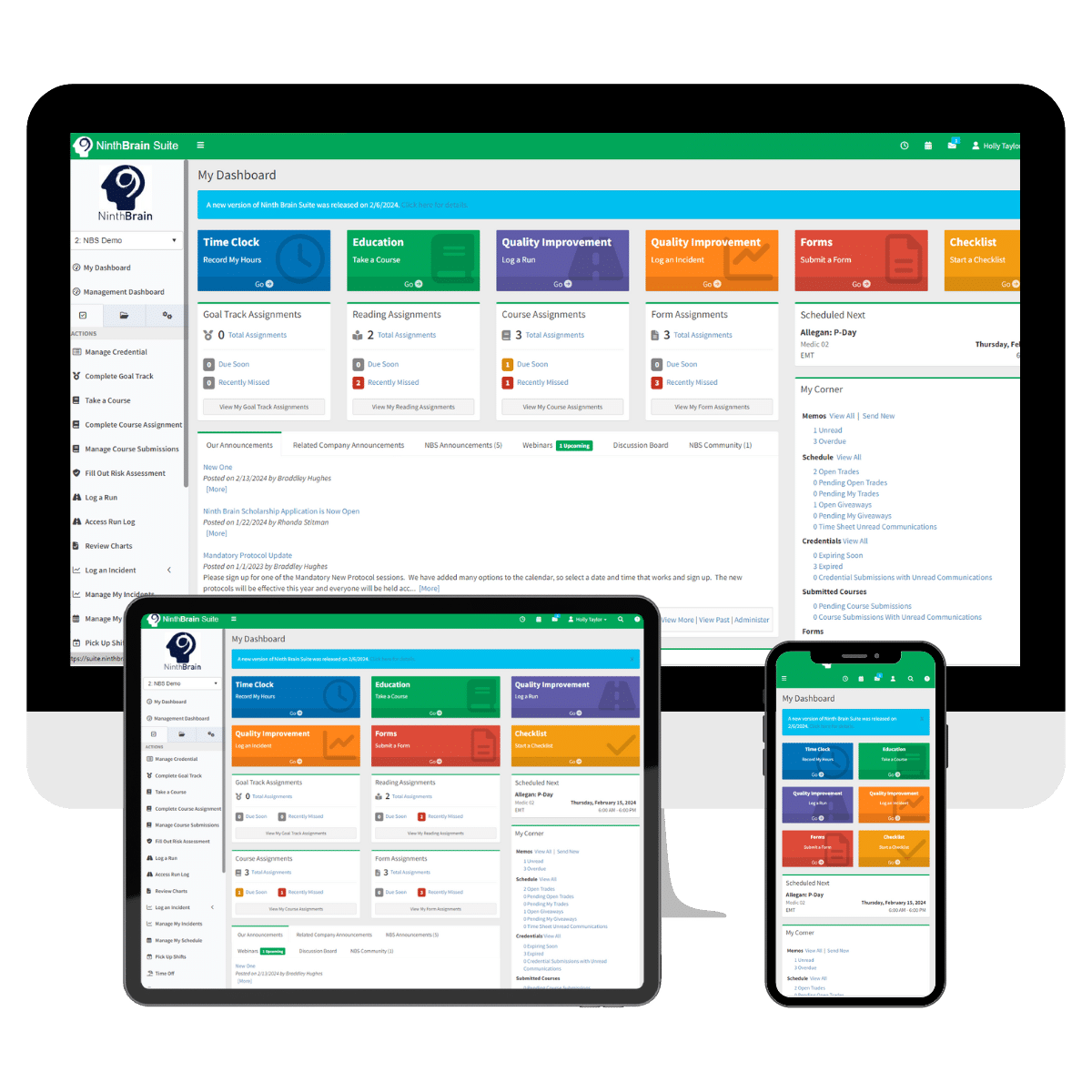
When our platform first started taking shape in the fall of 2001, managing an EMS workforce often meant binders, spreadsheets, and a list of expiration dates someone had to remember to check. Training records lived in one place. Safety plans and quality improvement plans lived in another. The documentation an accreditor might ask for was scattered across all of them.
That was the problem we set out to solve 25 years ago: give EMS organizations one place to manage OSHA and health and safety requirements, employee licenses, continuing education, quality improvement plans, and the records needed to run a team.
EMS has changed a great deal since then. Credential requirements have multiplied, from role-based certifications to multi-state compact licenses. Patient care is documented electronically. Accreditation standards keep evolving. And staffing a 24/7 operation remains one of the toughest jobs in the field.
The core needs haven’t gone away, but the work around them has become far more connected.
That’s the story of our first 25 years. Ninth Brain didn’t evolve by simply adding features. It evolved by connecting more of the work EMS organizations were already doing.
Where it started: the early platform
2001–2002: Virtual Clinical Manager
Development began in November 2001 under the name Virtual Clinical Manager. The idea was to act as a “virtual clinical manager” for an EMS organization: one place for company information, OSHA requirements, health and safety planning, the QI plan, safety data sheets, employee licenses, and course completions.
The first version launched in April 2002. It included:
- Employee health tracking for OSHA
- Basic license tracking
- Journal reviews
- A survey tool
- A task tracker
- “Ticklers,” our original name for alerts
2002: Virtual Solutions Manager
Later in 2002, the product became Virtual Solutions Manager (VSM). It was developed by a healthcare consulting firm specializing in training and compliance. Even then, VSM was built as a set of modules that each built on data collected in the others. The idea of connected work goes back to the very beginning.
2004–2005: Education and six modules
Education grew quickly. By January 2004, the platform delivered a true learning management experience with courses from an outside education partner, and a second partner added nursing courses that September. By 2005, the system included six modules:
- Health and Safety
- Employee Health
- QI Questionnaire and Survey Tool
- Journal Review
- Continuing Education
- Documents & Templates
2008: Becoming Ninth Brain
In 2008, the company took the name Ninth Brain and released Version 2, with a new look and menu structure.
From keeping records to connecting the work
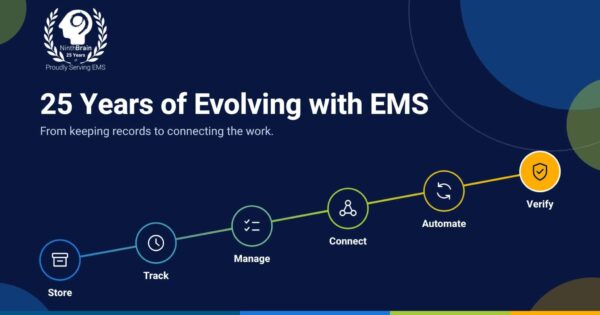
Look across the history of the platform and the same pattern shows up again and again. Each area of Ninth Brain has moved through some version of the same progression:
- Store: keep critical information in one place instead of scattered files.
- Track: know what’s due, what’s expiring, and what’s missing.
- Manage: handle the requirements and workflows around that information.
- Connect: link that work across modules, records, and people.
- Automate: take repetitive administrative steps off people’s plates.
- Verify: confirm, reconcile, and act on the information with confidence.
Credential management is a good example. It began in 2002 with basic license tracking and alerts. Over time it added role-based requirements, a direct connection to education in 2014, employee submissions and approvals, and ways to monitor and verify credentials against outside sources. Knowing when a credential expires turned out to be only one part of knowing whether the right person has the right qualification for the job.
25 years at a glance
Since becoming Ninth Brain in 2008, the platform has kept growing. Here are some milestones along the way.
2009–2016: Connecting the pieces
- 2010: Forms gain workflow and notifications
- 2013: Verification Monitoring launches
- 2014: Version 3.0 connects Credentials and Education, adds SCORM courses and dashboards; Checklist module created
- 2015: Audit trail added; a new partnership adds Fire and EMS courses to the library
- 2016: Version 4.0 brings a responsive design for any device, plus scheduled reports
2017–2022: Expanding into daily operations
- 2017: Scheduling module, Risk Assessment, and a patient safety organization integration
- 2018: Run Log and GAMUT Metrics; Scheduling time clock; first ePCR integration
- 2019: Leave management in Scheduling; a second ePCR integration
- 2020: Platform moves from physical servers to the cloud
- 2021: A La Carte Library adds more education providers
- 2022: Credential approval workflow introduced
2023–2026: Automating and verifying
- 2023: Goal Track learning paths, Public Forms, and Accreditation Assistant launch
- 2024: Forms connect to shifts; credential data reconciliation
- 2025: An upgraded ePCR integration (Run Log Connect); Goal Tracks can assign automatically
- 2026: A new ePCR integration added to Run Log Connect; EMS and Nursing Compact support; verification of CPR and life-support certifications
Built alongside the people doing the work
Many of these milestones didn’t start on a product roadmap. They started with an EMS organization describing a problem it was facing.
We held our first user group meeting in 2005 and a second in 2007, bringing clients together to share what they needed next. In 2008, we worked directly with an EMS agency to develop QI Incidents, shifting quality improvement from documenting a plan toward reviewing the actual events behind it.
Our first client signed on in April 2002, and they are still with us today. The tools changed because the people using them showed us what the work really required.
One anniversary, many stories
Throughout our anniversary year, we’ll share a series of timelines, each following one area of the platform from its first purpose to where it is today:
- Credentials: from license tracking to verified qualifications
- Forms: from a document repository to connected workflows
- Quality Improvement: from an annual plan to a continuous process
- Education: from course tracking to structured learning paths
- NBS Educational Library: from a single partner to a multi-provider library
- Verification Monitoring: from recorded credentials to ongoing verification
- Scheduling: built for the realities of a 24/7 workforce
- Accreditation Assistant: where 25 years of experience led
- Chart Review: bringing the patient chart and the reviewer closer together
Some stories go back to 2001. Others, like Accreditation Assistant, began in 2023 but build on everything that came before.
Still evolving with EMS
Looking back, one lesson stands out: an EMS team can’t treat credentials, education, scheduling, and quality improvement as separate jobs. A license expiration can change who is ready for a shift. A course completion can help recertify a credential. A chart review can reveal the training a crew needs next.
The work is connected, so the tools that support it have to be too. That’s what we’ll keep building toward: making it easier for EMS teams to see what’s complete, what needs attention, and what comes next.
We’ve spent 25 years listening, learning, building, and evolving with EMS. And we’re still doing it.
Next in the series: how credential management evolved from tracking expiration dates to verifying qualifications. Request a demo to see where the platform is today.